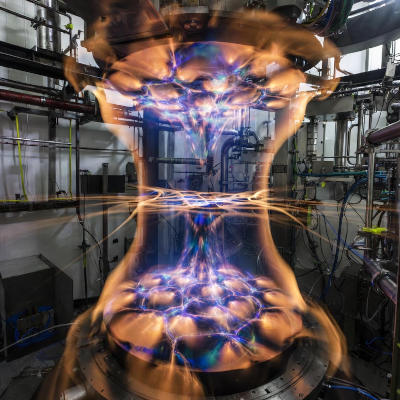

Nuclear fusion is the process that powers the Sun, where atomic nuclei combine to release energy, and it could provide clean power on Earth. To make it work, scientists must trap plasma - a hot gas of charged particles - at over 100 million degrees using magnetic fields and keep it stable. A key part is the electric potential inside the plasma, which is the voltage difference that controls how particles and energy move, helping to lock in the heat.
In the Large Helical Device, a fusion experiment machine, researchers use a tool called the heavy ion beam probe to measure this potential without touching the plasma. They shoot fast gold ions into the plasma and track how they change charge to figure out the voltage. But getting a strong, steady beam was hard, limiting accuracy.
The problem was in moving the beam from its source to the accelerator. Simulations showed that at high currents, the beam spreads out due to the space-charge effect, where like-charged particles push each other apart, causing losses.
Overcoming beam transport challenges
To fix this, scientists adjusted a multistage accelerator - a series of electrodes that speed up the beam - to act like an electrostatic lens, which focuses charged particles using electric fields. By tweaking the voltages, they boosted beam delivery by two to three times, as tests confirmed.
This upgrade let them measure plasma potential in denser conditions and spot quick changes over time. For example, when heating stopped, the potential dropped fast, then flattened, affecting how well the plasma holds energy. These details help refine models for controlling fusion reactions.
The new method is simple and can apply to other beam-based tools or accelerators. It builds a vital data set for designing future fusion reactors, improving stability and efficiency in plasma confinement. Overall, this step forward supports the goal of reliable fusion power.
The scientists described the methods and results of this study in a paper published in Nuclear Fusion.