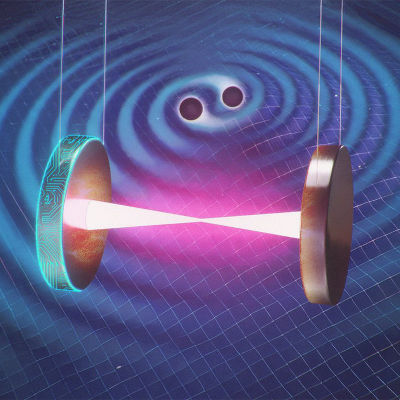

The Laser Interferometer Gravitational-wave Observatory (LIGO) measures very small movements, smaller than one ten-thousandth the width of a proton, to detect gravitational waves. LIGO has two sites, one in Washington and one in Louisiana. It detects gravitational waves, which are ripples in space-time caused by huge cosmic events like black holes colliding.
In 2015, LIGO made the first direct detection of these waves, leading to a Nobel prize in physics for its founders in 2017. Now, with upgrades, LIGO spots about one black hole merger every three days. Along with partners like Virgo in Italy and Kagra in Japan, LIGO has found hundreds of black hole mergers and a few involving neutron stars.
Researchers aim to improve ligo to find more types of mergers, including those with intermediate-mass black holes that fill the gap between small stellar-mass ones and huge supermassive ones at galaxy centers. They also want to detect black holes with eccentric orbits, meaning oblong paths, and catch mergers earlier as objects spiral together.
How AI helps reduce noise
To achieve this, scientists from Caltech and Gran Sasso science institute worked with Google DeepMind to create Deep Loop Shaping, an artificial intelligence (AI) method. This AI quiets unwanted noise in LIGO's mirrors. Noise here means small vibrations that interfere with measurements, often from ocean waves causing low-frequency shakes. LIGO's mirrors, weighing 40 kilograms each, hang in vacuum tubes and reflect lasers to spot tiny changes from gravitational waves.
The AI uses reinforcement learning, a technique where the system learns by trial and error. It reduces mirror motions 30 to 100 times more than old methods. Traditional controls counteract vibrations but add higher-frequency noise, like a hiss in headphones. The AI minimizes this, improving detection in the 10 to 30 hertz range, where hertz measures wave frequency. This helps spot bigger black holes and early merger stages.
The method was tested briefly and shows promise for longer use in LIGO, including future sites like LIGO India. It could also apply to other fields like aerospace and robotics for better vibration control. The work, published in Science, boosts LIGO's ability to explore the universe.