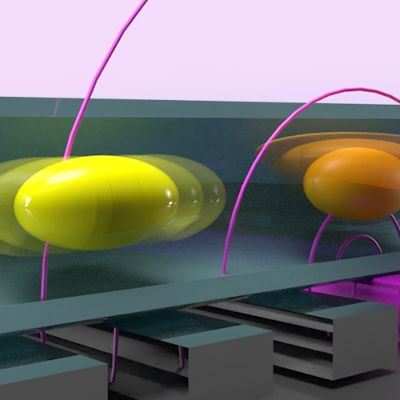

Quantum computers could help solve tough scientific and real-world problems that regular computers cannot handle. At the heart of these machines is the qubit, short for quantum bit, which is the basic unit of quantum information and can exist in multiple states at once, unlike a regular bit that is just 0 or 1. Qubits can be made in various ways, such as using the energy levels of atoms or the spins of electrons, where spin is a property of particles like tiny magnets pointing up or down.
The main challenge with qubits is a dilemma. They must be kept away from their surroundings to maintain quantum superpositions. If not isolated, these superpositions decay quickly, shortening coherence time, the duration quantum states last without disturbance. But to control qubits fast, like clocking in regular computers, they need strong contact with the environment, which usually speeds up decay.
Researchers led by the University of Basel have tuned a spin qubit to boost both speed and coherence time at the same time. Their work, published in Nature Communications, might help improve other qubits too.
Overcoming the qubit speed limit
The researchers built a small device from a germanium wire only 20 nanometers wide with a silicon coating. They removed an electron to create a hole, which acts like a positive charge and behaves like an air bubble in the wire. They used spin-orbit coupling, an effect where a moving charged particle generates a magnetic field that links to its spin and affects its energy.
By applying voltage, they mixed low and high energy levels of the hole, creating a plateau. This means pushing harder to drive the qubit does not make it faster but slows it, reducing sensitivity to environmental noise like electric fields. As a result, coherence time grew four times longer, driving became three times quicker, and it worked at 1.5 kelvin, a cold temperature but warmer than the usual below 0.1 kelvin, using less energy and no rare helium-3.
For now, this works in one-dimensional nanowires, but researchers hope to apply it to two-dimensional materials and other qubits. This could lead to stronger quantum computers.