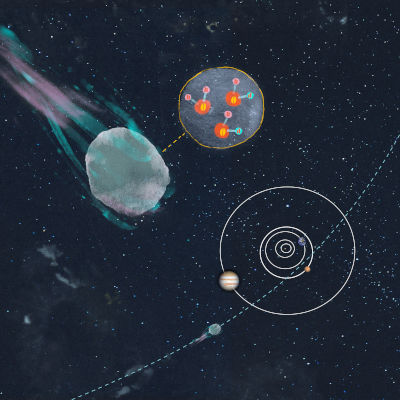

Astronomers discovered an interstellar comet named 3I/ATLAS less than a year ago. This object came from outside our solar system. Researchers at the University of Michigan have now studied its chemistry and found important clues about where it formed. The comet contains much more heavy water than objects in our solar system.
In this comet, a high number of water molecules include deuterium instead of ordinary hydrogen. Deuterium is a heavier form of hydrogen that has an extra neutron in its nucleus. Scientists measured the ratio of deuterium to normal hydrogen in the comet’s water. The value is 30 times higher than in any comet from our solar system and 40 times higher than in Earth’s oceans.
This high deuterium level points to formation in a much colder environment with lower radiation than the one that created our solar system. The finding shows that conditions for building planetary systems are not the same everywhere in the galaxy.
Chemical analysis of an interstellar visitor
The study used observations from two main telescopes. Researchers first spotted signs of gas coming from the comet at the MDM Observatory in Arizona. They then used the Atacama Large Millimeter/submillimeter Array, or ALMA, in Chile. ALMA is a group of radio telescopes that can detect very faint chemical signals. It allowed the scientists to measure the tiny difference between normal water and water containing deuterium.
The results provide direct proof that our solar system’s formation conditions are not common across space. Future interstellar objects can now be studied in the same way as more of them are discovered. The researchers note that clear, dark night skies are needed to spot these faint objects.
The work was published in Nature Astronomy. The study opens a new way to understand how planetary systems develop in different parts of the galaxy.