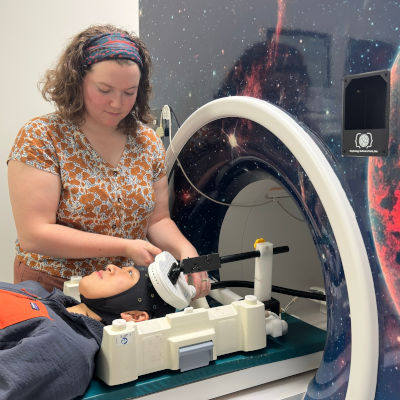

Researchers at the University of Iowa have shown that a noninvasive method of brain stimulation can change activity in a deep brain area important for emotion and memory. The study also found that adjusting the stimulation location based on each person's brain connections strengthens the effect.
Transcranial magnetic stimulation, or TMS, uses magnetic pulses from outside the head to influence brain cells without surgery or implants. The hippocampus is a small, deep brain structure that helps form memories and process emotions. Issues in this area are linked to conditions such as Alzheimer's disease, depression, anxiety, and post-traumatic stress disorder.
In the study, published in Nature Communications, the researchers worked with eight patients who already had recording electrodes placed in their hippocampus for medical reasons. This setup allowed direct measurement of brain activity during TMS. In four patients, resting-state functional magnetic resonance imaging, or fMRI, mapped each person's unique brain connections to find the best surface spot on the cortex most strongly linked to the hippocampus. The cortex is the outer layer of the brain.
Personalized brain targeting improves deep region response
When TMS was aimed at these individualized spots, it produced clear changes in hippocampal activity, including altered timing and patterns of brain waves. Both single pulses and repeated pulses of TMS worked. In contrast, standard non-personalized stimulation in the other four patients showed little or no effect on the hippocampus.
A separate part of the study involved 79 healthy volunteers. Using TMS together with fMRI, the researchers observed that stronger natural connections between the stimulation site and the hippocampus led to bigger responses in the deep brain area. Closer alignment to a person's ideal spot also improved results.
These findings provide direct evidence in humans that TMS can reach and influence the hippocampus when guided by individual brain connectivity. The approach may support safer, more effective treatments for brain disorders by offering precise, noninvasive control over deep brain functions. It could also help predict how well stimulation will work for each person.
The connectivity-guided method represents a step toward personalized neuromodulation, where treatments are tailored to brain wiring rather than using one-size-fits-all locations.