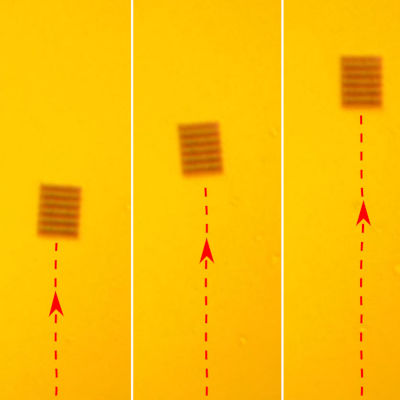

Researchers at Texas A&M University have shown that lasers can lift and steer small objects in any direction without touching them. This new method of light-driven motion could one day help spacecraft reach Alpha Centauri, the nearest star system, in about 20 years instead of hundreds of thousands of years with current rockets.
The study is published in Newton. The researchers used tiny devices called metajets, only tens of microns wide, based on special ultrathin materials known as metasurfaces. Metasurfaces are engineered layers with tiny patterns that precisely control how light reflects or bends, similar to how a lens shapes light but on a much smaller scale.
When a laser shines on a metajet, the light bounces off in a controlled way. This reflection transfers momentum, creating a gentle pushing force. By designing the patterns on the metasurface, scientists can direct this force to move the device forward, backward, up, or down. The researchers achieved full three-dimensional control, which had not been done before with this type of optical system.
How the new approach advances optical propulsion
Unlike earlier methods that shape the laser beam itself to move objects, this technique builds the control directly into the material of the metajet. This makes the system more flexible and easier to scale. The force produced depends mainly on the laser power rather than the size of the device, so the same principles could work for larger objects if enough light is available.
Experiments were carried out in a fluid to reduce the effect of gravity and allow clear observation of the motion. The devices were made with extreme precision at the university’s nanofabrication facility. The underlying physics comes from fundamental principles of how light carries and transfers momentum.
Although the current metajets are microscopic, the researchers believe the concept could apply to spacecraft in the future. The idea (pioneered in projects like Breakthrough Starshot) is to use powerful ground- or space-based laser arrays to push ultra-light sails on gram-scale probes. Continuous or prolonged laser illumination can accelerate these tiny craft to 15–20% of the speed of light.