Artificial Intelligence is no longer knocking at our door; it’s living in our house. In just under a decade, AI has transitioned from a far-future, complex, high-tech lab curiosity to an intimate force shaping our daily routines, relationships, industries, and even our sense of self. From so-called sentient chatbots writing our emails to algorithms recommending our diets and dates, AI is dissolving the boundaries between decision-maker and machine.
Fifteen years ago, I launched an initiative called iMakers. Its main objective was to create a maker society in Africa through public universities, with a focus on AI and robotics. It was a struggle, even among university professors, to explain why AI was relevant, as recently as seven or five years ago (before COVID). Today, it amazes me to see that even the most dim-witted and closed-minded politicians in the USA and Africa can now speak fluently about why AI matters.
Its capabilities are expanding at an almost gravitational pace. Language models can draft policy suggestions. Generative tools can build hyper-realistic virtual avatars, compose film scores, or even impersonate gestures and voices of the dead. Predictive systems anticipate our next job move, our illnesses, or our deepest emotional needs. These aren’t future predictions, they’re features already in the wild, evolving fast, mostly unregulated, and more importantly, inherently unregulatable. And yet, for all the marvels AI offers, it casts an equally long and growing shadow. The benefits are endless, but so too are the potential threats. As with any transformative technology, the dangers aren’t simply bugs in the system, they’re structural risks, emergent features, and tools that can be twisted. We must start naming and preparing for these dangers today, while we still have the agency to shape their trajectory.
Before we jump into the risks, it is important to clarify what kind of AI we’re talking about here. Most of the dangers outlined in this article stem not from symbolic AI, aka "Good Old-Fashioned AI" or GOFAI, which refers to classical rule-based systems that operate through logic, structured rules, and human-defined ontologies. The risks listed are mostly posed by generative AI. Unlike symbolic AI, which reasons based on explicit facts and relations, generative AI predicts outputs using statistical associations in massive datasets. It doesn't understand; it approximates. And therein lies the risk: generative AI is structurally incapable of logical reasoning or truth validation. It can produce, but it cannot verify. It can imitate, but it cannot judge. This makes it particularly susceptible to manipulation and, by extension, the perfect tool for the kind of mass-scale social and psychological harms detailed below. I want the readers to know the following truth: symbolic AI, with its strict deductive backbone, has its limitations, but it does not lie, fabricate, or improvise. Generative AI does all three by design!
Now, I will highlight some of these dangers, organized into short-term and long-term categories. The dangers discussed are not distant dystopian science fiction scenarios. Many are already unfolding or just around the corner. Each is assessed by its likelihood, reach, and the psychological or societal devastation it could unleash. This is part one, focusing on short-term risks. Part two will explore the long-term dangers.
Short-Term Shockwaves: Five AI Perils Already Stirring the Waters
The dangers listed below are categorized as ‘short-term’ not because their impact is less devastating or easier to control, but because many are already unfolding right now. These are not hypothetical scenarios; they are real, present, and escalating rapidly. What’s more alarming is that with the next major generative AI breakthrough, likely to arrive within the next two years, the scale and reach of these risks will grow exponentially. Unlike the old world’s threats that required well-funded organizations, radical ideologies, or dedicated groups, these AI-driven dangers can be launched by anyone with a laptop and a modest budget. A lone actor with as little as $100 and access to subscription-based or open-source AI tools can orchestrate large-scale psychological harm, financial disruption, or reputational destruction, only from a quiet suburban basement.

1. The Rise of Synthetic Blackmail: Deep Fakes, Deeper Damage
In the age of AI, blackmail no longer requires secrets but just data. With generative AI tools capable of fabricating hyper-realistic videos, audio, and images, malicious actors can now manufacture incriminating content tailored to their target’s fears. A politician might receive a video of themselves in a fabricated bribe scene. An influencer might see their face mapped into an adult film. A business leader could be framed in a corporate espionage call, while none of it real, but real enough to ruin a reputation.
As of writing, dozens of AI-powered ‘nudify websites’ are already ruining the lives of hundreds or even thousands of teenagers. These platforms allow anyone to upload a photo of another person—often without KYC or a jock-like KYC—and use AI to generate a highly realistic nude image of the victim. The results are disturbingly convincing, and once shared, they can spread rapidly across social media and private messaging groups. Victims, many of them minors, are left traumatized, socially isolated, and exposed to long-term psychological harm. The damage is immediate, and in many cases, irreversible.
What makes AI-enabled blackmail especially dangerous is its scalability. It doesn’t require a genius hacker, all it needs is only someone with access to an open-source face-swapping tool and a few minutes of training footage. The barriers to entry have collapsed. With just a public Instagram profile, bad actors can generate fake content in minutes and launch mass extortion campaigns with bot-assisted messaging to dozens or hundreds of targets simultaneously.
What’s more chilling is the psychological bind it places victims in. Even proving that something is fake often takes longer than the viral spread of the lie. By the time the truth surfaces, the damage is often irreversible: relationships lost, careers destroyed, or lives taken. The age-old threat of “I know what you did” has evolved into “I made what you didn’t do, and no one can tell the difference.”
Measuring this Risk: Probability, Spread, and Societal Harm of Synthetic Blackmail
The likelihood of synthetic blackmail escalating is not just high, it’s already happening! With open-source tools requiring minimal technical skill and public images readily available on social media, this form of extortion is scalable, decentralized, and disturbingly efficient. The reach is global, cutting across socioeconomic and geographical boundaries, and disproportionately harming vulnerable populations, especially public figures and minors. The psychological impact is severe: victims experience shame, anxiety, PTSD, and social withdrawal, often with no legal recourse. Societally, this introduces a toxic climate of fear and distrust, where reputations can be annihilated overnight by fiction indistinguishable from reality. The long-term consequence is a world where no image or voice recording can be taken at face value: an epistemic collapse in public trust!
2. Misinformation on Steroids: The AI-Powered Fog Machine
AI has democratized and decentralized deception. While misinformation and propaganda are as old as civilization, generative AI has supercharged them with a precision that makes the lie more persuasive than the truth. Fake news is no longer a typo-ridden Facebook post or grandpa website, it’s a full article with citations, images, and polished video commentary, all generated in minutes. The risk here is not just the generation of fake content but how AI can make that content appear well-founded. The same AI can then generate sources, both primary and secondary, as references. It can even create additional sources to support those primary and secondary ones. With its current capabilities, AI can build an entire world in hours, giving a lie so many layers of validation that it no longer looks like a lie. Combined with deepfake technology, those primary and secondary sources can appear to come from real authorities. We now live in a time where someone can create a story, complete with citations, that traces all the way back to the days of creation—overnight!
This distortion is most dangerous in regions with limited digital literacy or infrastructural safeguards (I am just being hopeful and assuming that now the people, crowd, or mob in the developed world have the rational faculty to conduct due diligence, which, by the way, seems dilapidated. I am witnessing that the vast majority of people in the developed world are abandoning rational faculty and embracing the opposite.). In parts of the developing world, where media verification tools are scarce and education systems are overstretched, AI-generated disinformation spreads like wildfire. Deep-faked political speeches, historical speeches, religious decrees, fake scientific results, or doctored ethnic conflict videos can trigger war, violence, panic, and destabilization.
The most frightening thing here is that the culprits are not just bad actors, the same old bogeymen: the likes of terrorists, radicals, conservatives, or Russia. I have witnessed governments in the western hemisphere, corporations, and passionate liberals flood information ecosystems with noise to drown out facts. Truth, in such an environment, becomes just another version of the narrative. AI doesn’t just spread lies; it corrodes our collective sense of what’s real. AI in the age of “post-truth” is a truly scary scenario that needs to be addressed today.
Measuring this Risk: Probability, Spread, and Societal Harm of AI-Powered Fog Machine
This threat is near-certain and already at play in both formal and informal media ecosystems. AI-powered misinformation is no longer crude; it is polished, multilayered, and self-reinforcing. Its reach is total, affecting democratic elections, public health campaigns, civil unrest, and even family beliefs. The psychological toll is the slow erosion of cognitive stability; people become uncertain not just of facts, but of their own ability to judge truth. Entire populations may become radicalized, cynical, or apathetic, creating a feedback loop where the more the lie is believed, the harder the truth is to recognize. In its most extreme form, this is not just a crisis of information: it is the engineered collapse of shared reality, a societal psychosis by design!
3. Bot-Fueled Market Distortions: The Adpocalypse 2.0
As AI bots begin to outnumber humans online, the internet risks turning into a performance staged for no one. Already, platforms are seeing floods of bot-generated engagement: likes, comments, reviews, and even full discussions designed to mimic human activity. Advertisers are pouring money into these spaces, assuming a human audience that may no longer exist.
The result is a massive distortion of value. Businesses measure success by clicks and impressions, unaware that most of the attention is synthetic. Entire campaigns are misdirected. SEO becomes a war between human relevance and bot-driven content farms. Brands spend millions targeting ghosts in the machine.
This chaos also undermines trust in digital spaces. When no one can tell if the person commenting on a product or praising a leader is real, engagement loses meaning. The internet becomes a hall of mirrors; echoes of automation feeding back into algorithmic metrics, leading companies and creators to optimize for illusions.
Measuring this Risk: Probability, Spread, and Societal Harm of Bot-Fueled Market Distortions
This risk is already materializing, albeit subtly. The prevalence of AI-generated engagement across platforms is distorting markets, analytics, and public sentiment in ways most stakeholders have not fully grasped. The likelihood of full-scale distortion is high, given that bot content is cheap, fast, and infinitely reproducible. Its reach touches everything from digital marketing to journalism to political campaigning. The societal fallout is twofold: economic waste and the degradation of public discourse. When entire markets are chasing phantom metrics and algorithms are tuned to respond to inauthentic stimuli, human creativity and effort are sidelined. Eventually, public confidence in online data erodes, leading to a digital economy optimized for fraud rather than value.
4. Education in Crisis: AI and the Erosion of Learning Integrity
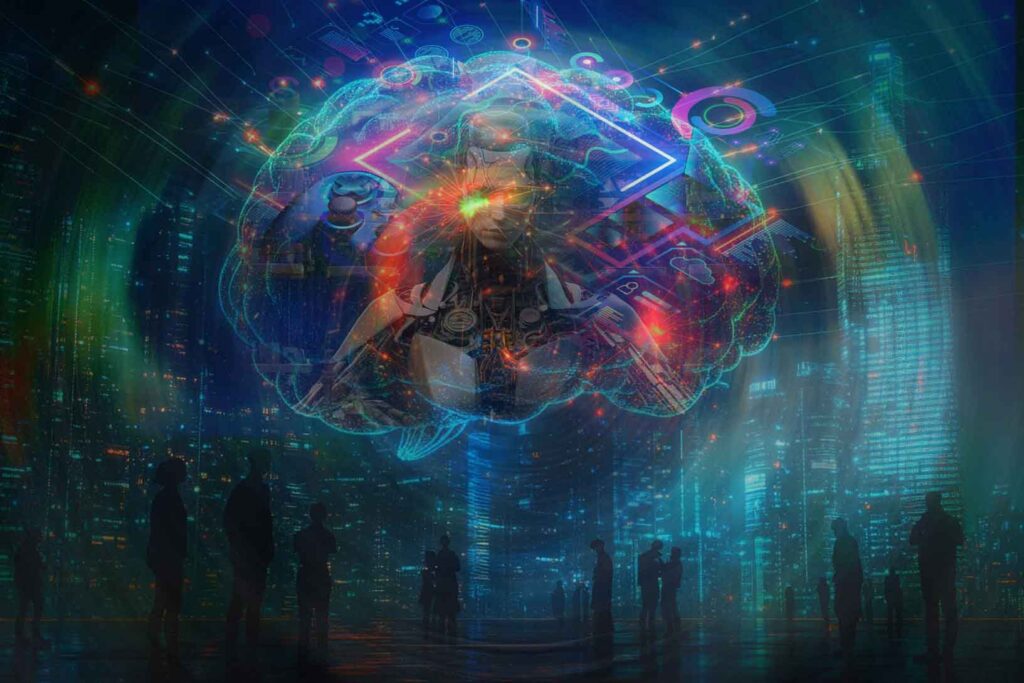
The education sector is on the edge of an AI-induced identity crisis. With language models capable of generating essays, solving math problems, or mimicking any teacher’s/student's voice and writing style, academic integrity is under siege. But the deeper threat isn’t just cheating, it’s the shifting perception of what education is for.
If AI can write a report, answer job interview questions, or even pass the bar exam, then why learn at all? By the same measure, if it can draft legal documents, diagnose patients, manage projects, create arts, drive cars, or code entire applications, then what exactly is left for the graduate to do with their education?
Students may increasingly see learning not as personal development, but as an outdated rite of passage. The question shifts from “what can I know” to “what can I delegate?” This mindset erodes not just academic rigor but the motivation for self-driven mastery.
In the short term, institutions are scrambling to adapt and deploy AI-detection tools, redesigning exams, and fostering oral assessments. But the existential question lingers: if intelligence is outsourced, what becomes of human capital? Even if AI doesn’t replace education and the entire workforce, it is rewriting its rules, and faster than most institutions can catch up. As generative systems normalize imitation over understanding, society risks a collapse in epistemic trust. The line between genuine knowledge and generated plausibility blurs, leading to intellectual stagnation, loss of meaning, and the slow decay of our ability to think, question, or value truth.
Measuring this Risk: : Probability, Spread, and Societal Harm of AI Induced Erosion of Learning Integrity, Epistemic Collapse, and the Loss of Meaning
The likelihood of AI-induced educational erosion is extremely high and accelerating. Generative AI not only supplies answers but also executes tasks, severing the link between learning and doing (With the current lame understanding of why we learn which goes like ‘you learn to get better paying jobs’, this risk can even accelerate faster than my estimation). As outputs become instant, coherent, and persuasive, the incentive to internalize knowledge, build skill, or engage in critical reasoning collapses. Why struggle to learn when the machine already knows and performs better, faster, and cheaper? This shift is not confined to schools or universities; its reach extends across all domains where learning once conferred mastery and subjective judgment—philosophy and the fine arts. From students bypassing basic literacy to professionals quietly abdicating expertise, AI flattens the landscape of cognition. At scale, it redefines intelligence as interface fluency rather than intellectual depth, breeding a generation fluent in prompts but bankrupt in understanding. The psychological consequences are corrosive: individuals begin to see thinking as obsolete, learning as inefficiency, and knowledge as a disposable means to an end. Over time, the capacity and will to learn may atrophy entirely. What dies is not just academic integrity or pedagogical rigor, but the very idea that truth matters or that understanding is worth the effort. This is the quiet collapse of intellectual sovereignty resulting a world where no one truly knows, and fewer still care.
5. The Infinite Scam Machine: AI as the Grifter’s Best Friend
Scamming has entered a golden age. With AI tools capable of cloning voices, writing emails in your tone, and creating perfect replicas of websites, the scammer no longer needs social engineering skills, AI is providing the perfect plug-and-play toolkit. A victim might get a voice note from their “son” in distress. Or an email from their “bank” that looks more legitimate than the real thing.
What’s most terrifying is the real-time layer. AI-driven scams will soon involve live video calls with deepfaked faces, facial expression tracking, and synthetic emotions. The target could be speaking to what looks and sounds like their CEO or mother. And in a high-stress moment, they won’t think twice before wiring money, revealing credentials, or surrendering control.
These scams won’t just be about money. They’ll also aim to manipulate behavior, extracting confessions, coercing political actions, or planting seeds of distrust. Every digital interaction becomes suspect. When AI blurs the line between human and machine impersonator, trust becomes the first casualty, and society pays the price.
Measuring this Risk: : Probability, Spread, and Societal Harm of the Infinite Scam Machine
The likelihood of AI-enabled scams reaching epidemic levels is near absolute. Scams have always adapted to new technology, but AI provides unprecedented realism and automation. The reach is terrifying: any individual with a voice, image, or phone number is now a potential mark. The devastation is equally financial and psychological. Victims are left doubting not just strangers, but friends, family, and institutions. The societal impact is corrosive: a breakdown of trust across every digital interface. As real-time impersonation becomes seamless, even high-trust environments like courts, hospitals, or emergency services could be infiltrated. This is not merely about theft; it is the industrialization of deceit, weaponized against the fabric of human trust.
Conclusion: A Crisis Met with Shrugs
Despite the magnitude of these short term risks and dangers, the global response has been staggeringly indifferent. AI companies continue racing for dominance, treating safety as an afterthought, if not a PR strategy. Regulatory bodies are slow, fragmented, and often captured by the very industries they aim to oversee. The United Nations, international courts, and policy institutions have barely moved beyond exploratory panels and soft declarations none of which match the urgency of what’s already unfolding.
This is not a matter of futureproofing. The threats are not theoretical. Teenagers are being publicly humiliated. Elections are being warped. Grandparents and parents are being robbed. Truth is being eroded. Learning is being hollowed out. And entire economies are being distorted by synthetic engagement. Yet the world watches with polite curiosity, not with coordinated action.
AI is no longer a novelty or a future possibility. It is a force, present 24 hours, already shaping minds, manipulating realities, and outpacing our institutions at every turn. And the institutions meant to safeguard us? They’ve chosen silence, or worse, partnership.
If anything is clear from this unfolding chaos, it is that the hype cycle around generative AI must be balanced by a deeper investment in symbolic systems. Symbolic AI, though far less fashionable, offers a logic-grounded framework that could serve as a safeguard: one capable of verifying outputs, flagging inconsistencies, and offering a transparent chain of reasoning. By integrating symbolic architectures into generative pipelines, we can slow the tide of fabrication and rein in the stochastic chaos with structure (‘stochastic chaos’ is the word of my choice because it describes a system or process where randomness (stochasticity) interacts with chaotic dynamics, resulting in behavior that is both random and highly unpredictable, making outcomes extremely difficult to forecast or control.). Symbolic systems could audit, supervise, and constrain the probabilistic engines now driving much of AI's expansion. The future doesn’t need to be a battle between logic and generation. It needs to be a hybrid where symbolic reason acts as a governor, a safety net, and a moral compass for generative power. If we are to survive the next wave of AI-induced disruption, that integration must happen now.