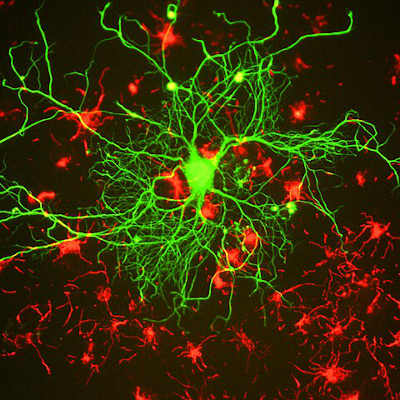

The brain is a complex organ with billions of neurons forming a dense network. Neurons connect through synapses, tiny junctions where signals pass, enabling memory and movement. Understanding this network requires detailed images of neuron connections.
A new method, LICONN, developed by scientists at the Institute of Science and Technology Austria and Google Research, uses light microscopy to reveal these connections. Light microscopy involves shining light through samples to see tiny structures. Unlike older methods, LICONN captures synaptic connections using standard light microscopes, making it accessible and efficient.
LICONN, short for light-microscopy-based connectomics, reconstructs brain tissue with high detail. This method also shows molecules involved in signal transmission alongside neuron structures. Scientists embed brain tissue in a hydrogel, a water-absorbing material. The hydrogel expands when water is added, stretching the tissue while preserving its structure. This expansion allows standard microscopes to see details as small as 20 nanometers, much finer than the usual 250-nanometer limit.
New possibilities with LICONN
The technique solves a major challenge in brain research. Traditional light microscopes struggle to see densely packed neurons. LICONN overcomes this by expanding tissue, making connections visible. It also uses deep learning to analyze complex image data. Deep learning helps identify neurons and synapses automatically, saving time. Scientists can map molecules critical for signal transmission, creating detailed 3D brain models. These models show how neurons link, forming networks that support brain functions like memory.
LICONN’s use of standard microscopes makes it practical for labs worldwide. It achieves high resolution without expensive equipment, unlike electron microscopy, which uses electrons to image samples. The method combines neuroscience, chemistry, and computer science. Researchers create vivid 3D visualizations, making complex data easier to understand. LICONN advances our ability to study the brain’s architecture, offering insights into its role in health and disease. This breakthrough brings scientists closer to unraveling the brain’s intricate puzzle.
The scientists have described the methods and results of this study in a paper published in Nature.