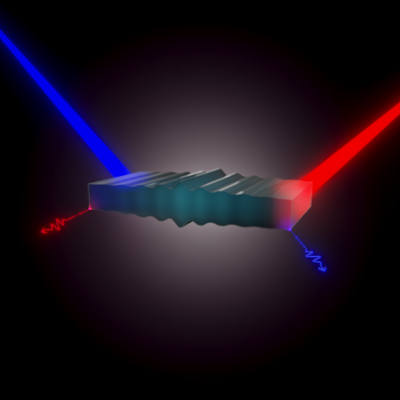

Quantum entanglement is when two particles, like photons (particles of light) or phonons (quasiparticles of sound), are connected in such a way that what happens to one immediately affects the other, no matter how far apart they are.
This connection, which Einstein called "spooky action at a distance," is key for new technologies like secure communication that can't be hacked, and for powerful quantum computers that leverage weird quantum effects.
Scientists at the Max-Planck-Institute have found a new way to entangle photons with phonons, the quasiparticles that carry sound.
Normally, entanglement is sensitive to things like heat or vibration (noise) from outside, which can mess up the quantum states. But this new method is tough; it can keep the entanglement stable even when there's noise around.
The scientists have described the methods and results of this study in a paper published in Physical Review Letters. An open preprint was previously published in arXiv.
The process they use is called Brillouin scattering, where light (photons) interacts with sound waves (phonons) in a way that links their quantum states. Think of it like a dance where light and sound waves move together in a special structure called a photonic waveguide. Here, sound travels slower than light, but because sound and light are entangled, changes in one will echo in the other instantly.
Robust entangled states
What makes this research stand out is that it can work at higher temperatures, around tens of degrees above absolute zero, rather than needing super cold conditions which are expensive to maintain. This makes it practical for real-world applications because it could be integrated into everyday devices like optical fibers or small chips used in quantum tech.
The findings opens up possibilities for using entanglement in more practical, less fragile quantum technologies, potentially making quantum communication and computing more accessible and efficient.
There is "great potential for applications in quantum computation, quantum storage, quantum metrology, quantum teleportation, entanglement-assisted quantum communication, and the exploration of the boundary between classical and quantum worlds," the scientists conclude in the preprint.