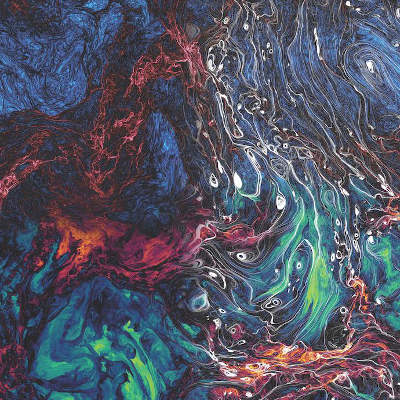

Scientists have studied turbulence, a chaotic motion of fluids like plasma. James Beattie, a researcher at Princeton University and a fellow at the Canadian Institute for Theoretical Astrophysics at University of Toronto, leads this work.
The scientists used the SuperMUC-NG supercomputer in Germany to create the largest-ever simulations of magnetized turbulence. Plasma is a hot, charged gas between stars. The simulations show how energy moves across scales in the interstellar medium.
Magnetic fields change this energy flow, reducing small motions and boosting wave-like patterns called Alfvén waves. These findings challenge old theories about turbulence. They help explain star formation, the movement of high-energy particles, and the Galaxy’s magnetic field.
Magnetic pressure opposes star formation by pushing against gravity in star-forming nebulas. Understanding turbulence improves space weather predictions, which affect satellites and future space missions. High-energy particles can harm humans in space, so this research aids safe space travel.
Two press release, one from Princeton University and one from University of Toronto describe this research, published in Nature Astronomy. A preprint was previously published on arXiv.
Model reveals cosmic insights
The simulation provides detailed insights into the Milky Way’s magnetic field. Though weak, this field shapes the cosmos by influencing turbulent flows. The model, a cube up to 30 light-years wide, captures extreme changes in density, from near-vacuum to dense star-forming areas. It scales down to study smaller events like solar wind, a stream of charged particles from the Sun affecting Earth. The model matches real solar wind data, showing its accuracy. It also improves our understanding of cosmic rays, high-energy particles traveling through space.
The scientists used the equivalent of 140,000 computers running together. This power allows the study of turbulence at unprecedented scales. As new instruments like the Square Kilometre Array measure turbulent magnetic fields, such models become crucial. They help interpret observations and advance knowledge of space weather, which impacts satellites and human safety in space. The research highlights turbulence’s universal nature, seen in galaxies, solar wind, and even a cup of coffee. The scientists aim to uncover universal turbulence patterns across the Universe. This next-generation models will push these discoveries further, offering deeper insights into astrophysical phenomena and space exploration challenges.