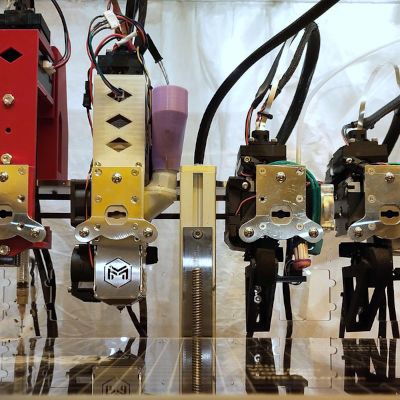

Factories often stop working when a motor breaks because finding or ordering parts takes time and money. Making a new motor right there would be better, but usually, this needs special tools and steps done only in big factories. Researchers at MIT created a new 3D-printing system that can make whole electric machines in just one go. This system uses different materials at once, like those that conduct electricity (let current flow) and those that are magnetic (create or respond to magnetic fields). It has four tools for extrusion - squeezing material through a nozzle - to handle various forms of feedstock (raw printing material), such as inks or pellets.
The printer switches between these tools with robotic arms, guided by sensors for exact placement. This keeps layers aligned, which is key for the machine to work well. Materials are chosen carefully; for example, conductive ones harden without much heat to avoid harming dielectric materials (non-conducting insulators that store energy).
How the system works
To test it, the researchers printed a linear motor - a device that moves in a straight line, used in robots or conveyors - in about three hours with five materials. After printing, they only magnetized the magnetic parts, and it was ready. This motor worked as well as or better than ones made with harder methods, costing around 50 cents in materials. It made stronger motion than some common types that need extra parts like hydraulic amplifiers (devices using fluid pressure to boost force).
In the future, this could let people make custom parts for robots, cars, or medical tools quickly, with less waste. The researchers plan to add steps like automatic magnetization and print rotating motors too. They also aim for monolithic fabrication - making devices as one solid piece - to create even more complex electronics easily. This could change how things are built, moving away from long supply chains.
This research is published in Virtual and Physical Prototyping.