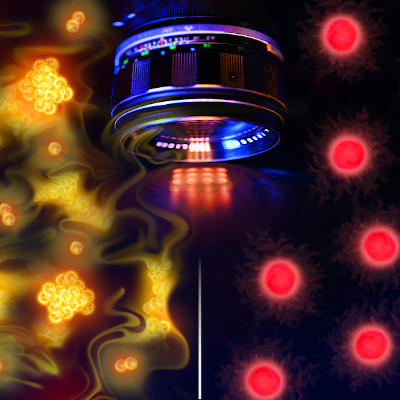

MIT physicists have developed a new method to photograph single atoms moving freely in space. These images show how atoms connect in ways scientists predicted but never saw before. The findings, published in Physical Review Letters, help researchers understand quantum phenomena.
The physicists created a technique to capture these images. They let a group of atoms, called an atom cloud, move and interact without restrictions. Then, they used a light grid, known as an optical lattice, to briefly hold the atoms still. The lasers quickly lit up the atoms, showing their exact positions. This method produced clear pictures of the atoms before they scattered.
The researchers used this technique to study different atom types. They photographed bosons, atoms that tend to group together, forming a wave-like pattern called a Bose-Einstein condensate, a state where atoms act as one due to extreme cold. They also captured fermions, atoms that usually push apart but can pair up, a process key to superconductivity, where electricity flows without resistance.
Inside the cloud
An atom measures about one-tenth of a nanometer, a billionth of a meter, much smaller than a human hair. Atoms follow quantum mechanics, making them hard to predict. Traditional imaging, like absorption imaging, shows the cloud’s shape but not individual atoms. This method uses laser light to cast a shadow of the atom cloud onto a camera.
The new technique, called atom-resolved microscopy, works differently. Scientists trap atoms loosely with a laser beam, letting them interact freely. A light grid then freezes them in place, and another laser makes them glow, revealing their positions. This method avoids disturbing the atoms, which is tricky because too much light can push them away.
The physicists observed bosons bunching together, sharing a single quantum wave, a behavior tied to the de Broglie wave, a concept suggesting particles are driven by pilot waves. They also saw fermions pairing, a key step in certain physical processes. These images make abstract theories visible, showing real interactions. The researchers plan to use this method to explore complex quantum behaviors, like quantum Hall physics, where electrons act strangely in magnetic fields, helping confirm or challenge existing theories.