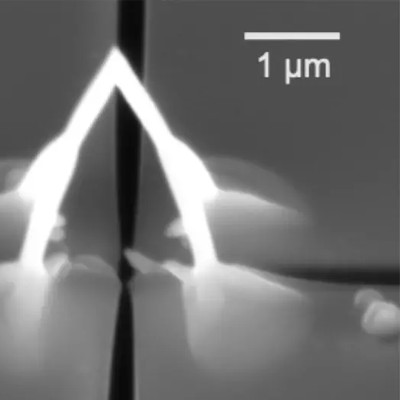

Scientists led by Max Planck Institute for Chemical Physics of Solids have developed a new way to make tiny three-dimensional structures using a nano 3D printer that works at the nanoscale.
They created superconducting nanostructures, meaning very small objects that can conduct electricity with zero resistance. Superconductors let electricity flow without losing energy and push away magnetic fields. The researchers showed they can control the superconducting state in these tiny structures. They can turn it on or off by rotating the structure in a magnetic field, which is a force that attracts or repels objects.
The study, published in Advanced Materials, reveals new possibilities for technology. Moving from flat, two-dimensional shapes to three-dimensional ones changes how materials work. For example, folding a paper into an airplane or twisting a wire into a spring alters its function. At the nanoscale, shaping materials in 3D allows scientists to change their properties. These changes create fresh opportunities to design materials with specific abilities, especially in quantum materials.
Controlling superconductivity
The scientists faced a big challenge: making complex 3D shapes at the nanoscale in quantum materials. They solved this by using a technique like a nano 3D printer. The scientists built a 3D bridge-like superconductor and controlled its superconducting state in specific areas. They even observed tiny defects called superconducting vortices moving in three dimensions. Vortices are small flaws in the superconducting state that can affect how the material works. The scientists say controlling the superconducting state at this scale is crucial for discovering new effects and building future devices.
By switching superconductivity on and off in different parts of the structure, the researchers created a reconfigurable device. The scientists explain that this ability to adjust the device opens doors for advanced technology. The findings support the development of adaptable superconducting components, which could lead to new logic systems or brain-like computing designs. This work sets the stage for innovative superconducting technologies in the future.