
Researchers at the Weizmann Institute of Science developed a new nano-MRI device. MRI scans take pictures of the body using magnetic fields. Regular MRI machines in hospitals show details down to one-tenth of a millimeter. However, this is not enough to see individual molecules.
The new device scans at one nanometer, which is one millionth of a millimeter. This allows it to see the tiny parts of a single molecule. The researchers shared their findings in Nature Communications Physics.
MRI works by measuring spin, a magnetic trait of particles that acts like a spinning top and has a resonance frequency. Resonance frequency is how fast the particle spins, measured by the MRI. In regular MRI, a gradient magnetic field changes strength across the body. This helps the machine see different tissue slices. A stronger gradient shows thinner slices. The researchers wanted to use this idea to see particles in a molecule.
Using Diamond Sensors for Better Scans
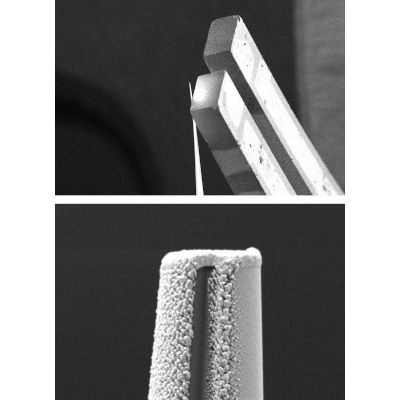
The researchers used a synthetic diamond with a tiny defect called a nitrogen-vacancy center. This defect acts as a sensor. It changes the red light it gives off based on nearby spins. This sensor can detect very weak signals, like a particle 50 nanometers away. However, it struggled to tell apart nearby particles. The new device uses a quartz tip with a gold conductor shaped like a square arch. Electric current through the gold creates a gradient magnetic field. This field changes the resonance frequency of atoms based on their position in the molecule.
The device achieves a resolution of one nanometer. It can turn the magnetic field on and off quickly, in 0.6 millionths of a second. This makes scans more accurate. The nano-MRI works at room temperature, unlike older methods. It needs only a small sample to test materials or drugs. This helps the materials and pharmaceutical industries. It can show why some substances act differently in real life. The device might even reach higher resolutions in the future.