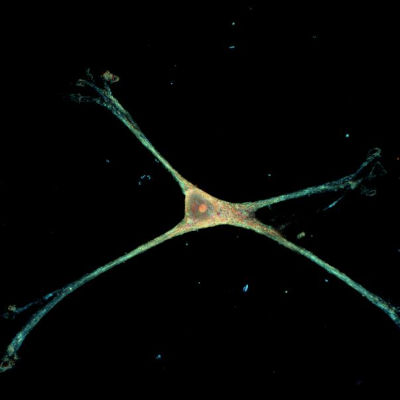

Scientists from Johns Hopkins University and the National Research Council of Italy have developed a new technology to study specific brain cells called astrocytes. Astrocytes are the most abundant cells in the human brain, acting as a physical support system and helping to manage communication between neurons.
Despite their importance to human health, these cells are notoriously difficult to study in a laboratory setting. In their natural state inside a living organism, they take on a complex star shape. However, when researchers attempt to grow them on standard flat glass dishes, the cells typically collapse and lose this distinct form. Since the physical form of the cell is likely linked to how it functions, this flattening effect has created a major gap in understanding brain health and diseases such as Alzheimer's and Parkinson's.
Replicating the brain environment
To overcome this obstacle, the researchers engineered a platform that mimics the physical texture of actual brain tissue. They utilized nanowires, thin wire-like structures often measuring just a few nanometers in diameter, to build a special mat. This mat is made of glass and remains transparent, which is essential for visual observation. When placed on this nanowire surface, the astrocytes recognized the texture and maintained their signature star-like shape, branching out and maturing as if they were still inside the brain.
The researchers combined this new physical platform with a sophisticated imaging method. This technique captures high-resolution, three-dimensional views of the cells without requiring fluorescent tags, which are chemical dyes usually added to make biological structures visible under a microscope. By avoiding these invasive stains, the scientists could observe the cells in a completely natural state. This allows for precise measurement of how astrocytes grow and change. The researchers believe this method will advance "brain on a chip" models. This could lead to better testing for drug effects and a deeper understanding of neurodegenerative disorders.
The researchers have described the methods and results of this study in a paper published in Advanced Science.