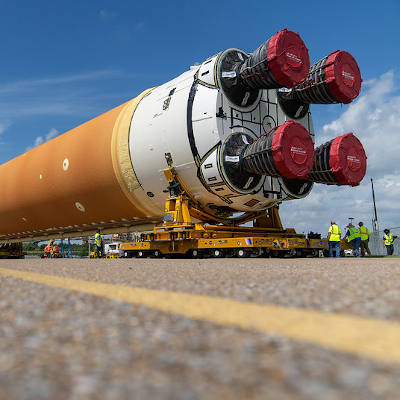

Nasa hopes to launch its Artemis II mission as soon as February, earlier than its previous plan of no later than April, BBC News reports. The launch window could open as early as the fifth of February.
This would be the first time in 50 years that people fly around the moon. The mission involves four astronauts testing the spacecraft and rocket to prepare for later landings on the moon's surface. The Artemis program aims to return humans to the moon and build a long-term base there. A Nasa official called it a key step in space exploration, stressing that safety comes first. The Space Launch System (SLS) is almost ready. Only the crew capsule Orion needs final work and tests.
The first Artemis mission in 2022 sent an empty Orion around the moon. It succeeded overall, but had problems with the heatshield, which Nasa has fixed. For Artemis II, the astronauts are from Nasa and the Canadian Space Agency. They will not land but go around the Moon and return to Earth. The crew will travel over 9,000 kilometers past the moon, farther than any before.
Mission journey and tests
The launch starts with SLS lifting Orion into Earth's orbit, helped by solid rocket boosters. Then the core stage separates after eight minutes. Orion's solar arrays open to power the craft. After checks, Orion separates and does a practice maneuver to test docking (connecting spacecraft in space). A burn from the service module sends it toward the moon for four days. Astronauts will check systems and act as test subjects for how space affects the body. After looping past the moon, gravity pulls Orion back for four days. The service module detaches, and the capsule re-enters Earth's atmosphere, using parachutes to land in the ocean. Success could lead to Artemis III, a landing mission, but experts say mid-2027 is optimistic due to the need to develop a lunar lander and other hardware.