
Computers today often use artificial intelligence (AI), but AI systems need costly training with huge amounts of data. Neuromorphic computing aims to change this by designing hardware that copies the brain's structure for more efficient AI tasks. This could cut down on power use and allow AI to run on everyday devices like phones without relying on big data centers.
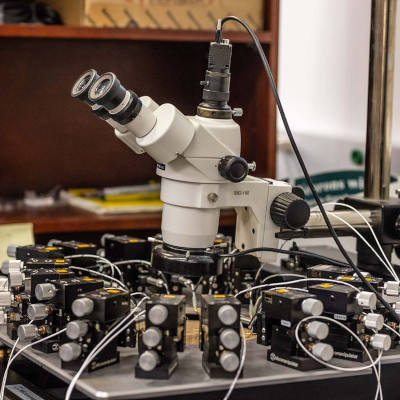
Researchers at UT Dallas, Everspin Technologies, and Texas Instruments, built a small neuromorphic computing prototype that learns patterns and predicts outcomes using far fewer steps than standard AI. The device shows how such systems might work in real-world tools without high energy demands. Friedman noted that this could power smart devices at low cost.
The researchers have described the methods and results of this study in a paper published in Communications Engineering.
How the prototype mimics the brain
Normal computers keep memory and processing separate, which slows AI and raises costs. Neuromorphic designs combine them, like the brain's neurons, which are nerve cells that process signals, and synapses, connections that store and adjust information. The prototype follows Hebb's law, according to which linked neurons strengthen their bonds when active together.
“The principle that we use for a computer to learn on its own is that if one artificial neuron causes another artificial neuron to fire, the synapse connecting them becomes more conductive,” said research leader Joseph Friedman in a press release issued by UT Dallas.
A key part is magnetic tunnel junctions, tiny devices with magnetic layers separated by insulation, where electrons tunnel through more easily if layers align. These act like synapses in networks, adjusting to patterns and storing data reliably. This binary switching, or on-off states, solves problems found in other brain-like systems. The next step is making larger versions for practical use, which could make AI greener and more accessible.