
Artificial intelligence (AI) has led to big advances in many areas, but it often fails to follow basic physics laws. People naturally understand that objects fall, bounce, and push back with equal force, and they can apply this to different sizes or types of things. However, AI models struggle with this, especially in complex, time-changing processes like human movement, particle collisions, or machine gears. These models build up errors over time, leading to unrealistic predictions. On the other hand, traditional physics models strictly obey laws but need huge amounts of computing power and time, particularly for systems with many interacting parts. They also might not match real-world data perfectly and require changes for new setups.
To fix this, researchers at EPFL developed an algorithm called Dynami-CAL GraphNet. It builds Newton's third law - every action has an equal and opposite reaction - directly into AI structures. The algorithm, which uses a graph neural network, or GNN, works for systems with many parts that affect each other. By embedding the law, the algorithm ensures predictions stay consistent with physics, avoiding strange or impossible results even in new situations.
Testing the new approach
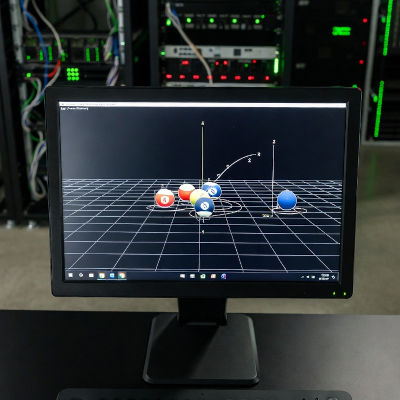
The researchers tested Dynami-CAL GraphNet on real examples. It modeled collisions in groups of small spheres, like in a mixer, starting from simple training data with few particles and scaling up to thousands in moving setups. It also predicted human walking from basic motion data, without extra details on ground forces. At a tiny scale, it handled protein molecules in liquid, forecasting small shape changes over time. Unlike other AI, this one stayed stable for over 16,000 steps without drifting from physics rules.
The algorithm needs little training data but can apply what it learns to bigger or different systems. Its results are clear and easy to check, showing step-by-step calculations of forces and momentum that follow laws. This builds trust, especially for important uses like engineering.
This research is published in Nature Communications.