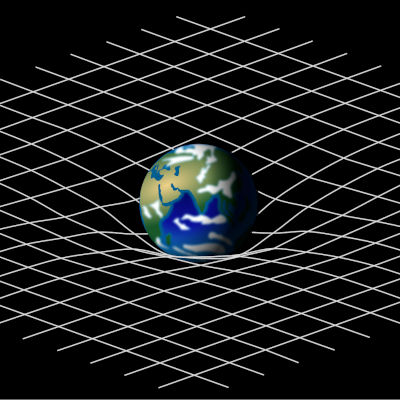

Scientists have developed a new artificial intelligence (AI) method called AInstein to find mathematical descriptions of how space curves due to gravity, based on Einstein's field equations of general relativity. These equations explain how matter and energy shape spacetime, the combined fabric of space and time. Traditionally, solving them for complex spaces required assuming symmetry, like even shapes, and heavy computations. AInstein uses semi-supervised learning, a type of artificial intelligence that learns from some labeled data and lots of unlabeled data, to approximate these metrics without those assumptions.
The method represents curved spaces (manifolds) as overlapping coordinate patches, small sections like map pieces. Each patch has a subnetwork, a small neural network, that predicts the local metric, the rule for measuring distances and curves there. It includes the Einstein field equations as part of its training loss. Training loss is a number that shows how wrong a model's guesses are during learning. The goal is to make this number as small as possible by adjusting the model over time.
The equations set curvature minus a constant times the metric to zero. The constant, lambda, allows for positive, zero, or negative curvature, like expanding, flat, or contracting universes.
The scientists have described the methods and results of this project in a paper published in AI for Science. They have also published the code for this project in a GitHub repository.
Ensuring global consistency
To make the whole space consistent, AInstein ensures metrics match between patches. This creates a smooth global structure.
Tests on spheres in two to five dimensions showed that AInstein works well. In lower dimensions, it matched known geometries. In higher ones, it supported a mathematical conjecture that no special metrics called Ricci-flat metrics exist.
This approach shows neural networks can solve nonlinear differential equations for physics. It could study exotic spaces, black holes, or other curved areas hard to analyze. The authors note it opens computational paths for hidden solutions, bridging AI with deep physics questions.