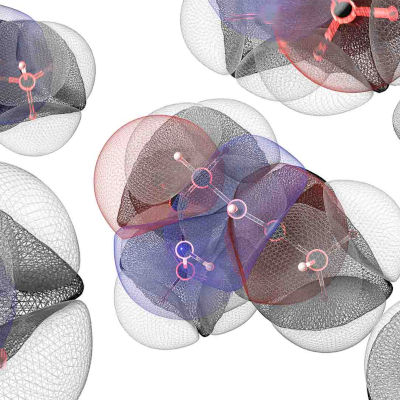

Scientists at the University of Manchester have created a new physics-informed artificial intelligence (AI). This machine-learning model can run stable molecular simulations for much longer times than before, even at temperatures as high as 1000 Kelvin, which is far above normal room temperature. The study is published in Communications Chemistry.
Machine-learned potentials, or MLPs, are computer models that try to copy the complex rules of quantum mechanics to predict how atoms in molecules move and interact. Most existing MLPs become unstable when molecules get hot, move a lot, or change shape, causing the simulated molecules to break apart. The new model solves this problem by building real physical knowledge directly into the artificial intelligence. It uses a method called Gaussian process regression, which is a statistical way for the computer to learn patterns from data based on known physics rules. A small but important mathematical choice, known as the prior mean function, gives the model a realistic starting point. This helps the AI keep molecules together and behaving naturally even under stress.
Building more reliable AI molecular models
The researchers tested the model with fifty separate simulations, each running for 10 nanoseconds. Together these added up to 0.5 microseconds of stable movement, a rare achievement for this type of AI model. Flexible molecules such as aspirin, serine, and glycine stayed intact. The model also fixed distorted structures and correctly reproduced known shapes of benchmark molecules like alanine dipeptide. It runs efficiently on ordinary computer processors without needing powerful graphics cards.
This advance means scientists can now study how molecules behave over long periods and in extreme conditions more reliably. Such simulations are important for developing new drugs, designing better materials, and creating sustainable chemical processes. The work shows that focusing on stability, not just accuracy, leads to models that actively prevent unrealistic behaviour. Researchers plan to extend the approach to include more detailed electron effects and make the models work for a wider range of molecules.
The development offers a practical way to perform accurate, long-running simulations on standard hardware, reducing the need for expensive supercomputers and opening new possibilities in chemistry and materials science.