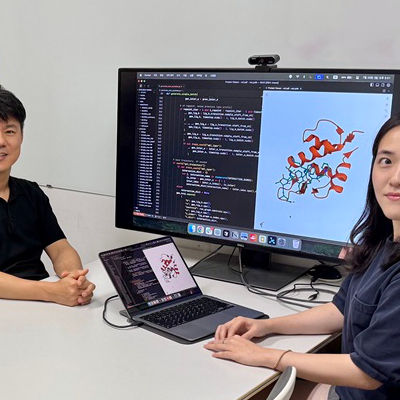

Traditional ways to develop drugs start by finding a target protein, such as a receptor on cancer cells. Then, scientists test many possible drug molecules to see which ones can attach to the protein and stop it from working. This method costs a lot of money, takes years, and often fails.
Now, researchers at KAIST have made an artificial intelligence (AI) model that designs. drug candidates using just details about the target protein, without any earlier data on molecules that might bind to it. It also predicts how the drug and protein connect through non-covalent interactions, which are weak forces like hydrogen bonds that hold molecules together without forming strong chemical links. The work is published in Advanced Science.
Older AI tools either made molecules first or checked binding separately. This new one thinks about the binding process while creating the molecule, all in one go. It looks at key factors for how proteins and ligands, which are small molecules that bind to proteins, interact. As a result, it makes molecules more likely to work well and stay stable.
Innovation in generation and optimization
The AI uses a diffusion model, a type of generative AI that starts with random noise and slowly refines it into a clear structure, similar to how some image-creating tools work. This is like AlphaFold 3, a tool that won the 2024 Nobel Prize in Chemistry. This model adds guides based on real chemical rules, such as proper bond lengths and distances between protein and ligand, to make results more realistic.
It meets several drug design goals at once, including strong binding affinity, which measures how tightly the drug sticks to the protein; drug-like properties, meaning the molecule acts like a good medicine; and structural stability, ensuring it does not fall apart easily. Older models often focused on just one or two goals, ignoring others. Researchers improved it by reusing good binding patterns from past results, without extra training. For example, it created molecules that target mutated parts of EGFR, a protein linked to cancer.