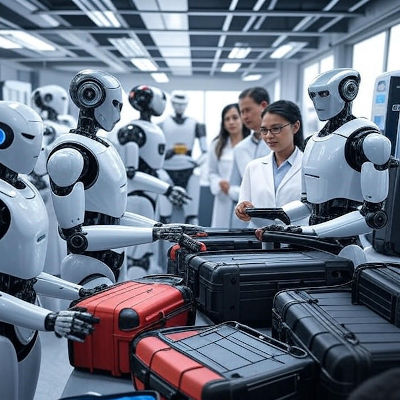

Packing a suitcase for a summer vacation is usually easy for people because they can visualize how items fit together. Humans can adjust things to make sure everything fits securely without breaking anything delicate. For robots, however, this task is very difficult. It involves planning many actions at once, considering the robot’s abilities and limitations, and avoiding problems like bumping into objects. Finding a good solution can take a robot a long time, if it can find one at all.
Researchers from MIT and NVIDIA have found a way to make this process much faster. Their method allows a robot to think ahead by testing thousands of possible solutions at the same time. It then improves the best ones to meet the robot’s needs and the space it’s working in. Unlike older methods that check one action at a time, this approach solves complex tasks in just seconds. The researchers use powerful GPUs to handle the calculations quickly.
Planning in parallel
The new algorithm is designed for task and motion planning, which means figuring out both the big steps a robot needs to take and the small details, like how to move its arm or gripper. For example, when packing a box, the robot must decide how to place items so they fit together, pick them up without knocking anything over, and follow any specific rules, like packing items in a certain order.
With so many possibilities, checking each one individually would be too slow. Instead, the algorithm, called cuTAMP, tests thousands of solutions at once using parallel computing. It starts by choosing solutions likely to work, then refines them by checking how well they avoid collisions and meet other requirements. By repeating this process, it quickly finds a good plan.
The method is described in a preprint published in arXiv. In tests, cuTAMP solved packing problems in seconds, even on real robots, and could work for other tasks like using tools. The researchers hope to improve it so robots can follow voice instructions in the future.