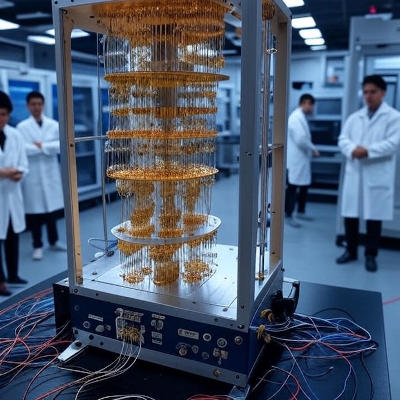

Computers should handle combinatorial optimization problems, which are tasks like planning telecom networks, schedules, or travel routes to boost efficiency. Current computers face limits in packing more processing power into chips, and training artificial intelligence models (AI) uses huge amounts of energy.
Scientists at UCLA and UC Riverside have shown a new method that gets around these issues for some tough optimization problems. They created a system that uses a network of oscillators, which are parts that swing back and forth at specific frequencies, to process information instead of using all-digital data. This setup, known as an Ising machine, excels at parallel computing, meaning it does many complex calculations at the same time. When the oscillators sync up, the problem gets solved.
Room-temperature quantum-inspired computing
The device relies on quantum properties that connect electrical activity with vibrations in a material, but unlike most quantum computers that need very cold temperatures to keep their quantum traits, this one works at normal room temperature.
This method is called physics-inspired computing, which uses natural physical events to do calculations directly, leading to better energy use and faster results. The oscillators naturally shift to a ground state, their lowest energy level where they align, helping solve the optimization tasks.
The scientists used a special material called tantalum sulfide, a quantum material that allows switching between electrical and vibrational states, bridging quantum mechanics and regular physics. The prototype offers low-power use and can work with standard silicon technology. It was made in a UCLA lab for nanofabrication and tested in another for phonon-optimized materials. Funding came from the Office of Naval Research and the Army Research Office. This technology could lead to more efficient computers for real-world problems.
The scientists have described the methods and results of this study in a paper published in Physical Review Applied.