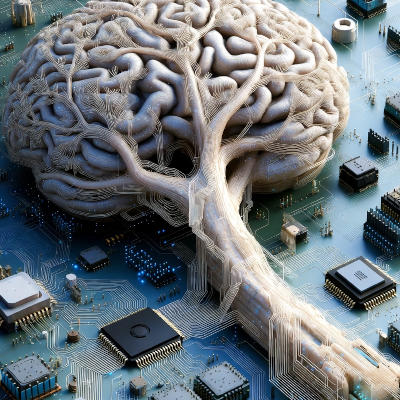

The human brain uses only about 20 watts of power, like a dim light bulb, yet it processes information very efficiently. For the past 30 years, computer scientists have worked on neuromorphic computing, a field that designs devices to mimic how networks of synapses handle data. This has led to special chips from companies like Intel and IBM that save energy compared to regular computers.
However, these neuromorphic chips are slower, creating a tradeoff between energy savings and speed. Breaking this limit would allow more performance per unit of energy. To help, experts are turning to stochastic thermodynamics, a branch of physics that examines energy costs in systems not in balance, such as modern computers.
A promising collaboration
The experts met at a three-day working group in December at the Santa Fe Institute, funded partly by the National Science Foundation. Thirteen experts from both fields - neuromorphic engineering and stochastic thermodynamics - met to share knowledge and ideas. After years of exploring different designs for neuromorphic advantages - gains in efficiency over traditional methods - researchers see untapped potential in random noise and tiny changes during computation. Stochastic thermodynamics offers tools to use these elements better.
Stochastic thermodynamics extends conventional statistical physics to systems that are arbitrarily far from thermal equilibrium, with arbitrarily many degrees of freedom that are all changing on fast timescales.
Current neuromorphic work focuses on what devices do, not the physics behind them. This meeting aimed to deepen understanding by linking the fields. Participants quickly saw connections, like a successful first meeting. It ended with plans for more joint work and gatherings to advance the ideas.
Overall, this exchange could push neuromorphic computing forward, making devices that copy the brain's efficiency without losing speed. By harnessing physics insights, future computers might handle complex tasks with less power, opening new possibilities in technology.