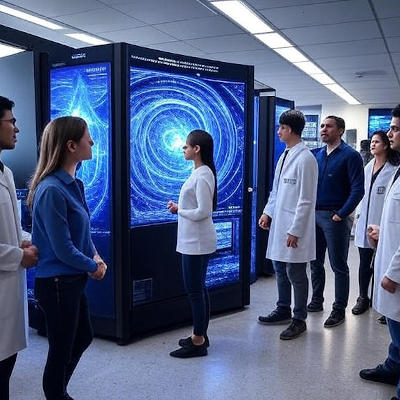

Engineering could advance much quicker with an artificial intelligence (AI) oracle able to respond to any physics query. This is the broad goal of the newly formed Center for Prediction, Reasoning and Intelligence for Multiphysics Exploration, or C-PRIME, led by the University of Michigan and funded with $19.4 million by the U.S. Department of Energy’s National Nuclear Security Administration.
Physics follows many known equations, but turning them into predictions for real objects is difficult. Examples include fuel and air swirls in detailed engines or exact wind resistance on vehicle surfaces. In principle, all can be figured from the molecule scale, but the needed calculations are far too massive to carry out.
AI agents could construct physics models from established equations to make dependable simulations operating on top supercomputers.
Advancing AI in physics
The project divides into five research areas. One handles core physics, crafting models refined by experiments on material mixing and reactions. Another explores verification, validation, and uncertainty quantification, assessing how model simplifications impact forecasts. A third tunes models for exascale supercomputers, machines performing a quintillion operations per second, and sets bases for AI-optimized future systems. The fourth crafts machine learning tools to hasten complex physics computations from AI agent data. The fifth creates AI agents for physics equation integration, coding, and simulations.
C-PRIME will address applied physics problems in, for example, rotating detonation combustors and hypersonics, and validate results with custom lab tests.
This project is expected to influence physics and engineering through research and training the next generation, ensuring students and postdocs master AI use for future success.
The National Nuclear Security Administration commends the center for aligning with goals in predictive simulations, expecting major advances in hypersonics and exascale computing for security.
C-PRIME includes partnerships with national labs like Los Alamos. It features 13 co-investigators from the university across departments, one from Princeton University, and collaborators from Sandia, Los Alamos, and Lawrence Livermore national laboratories.