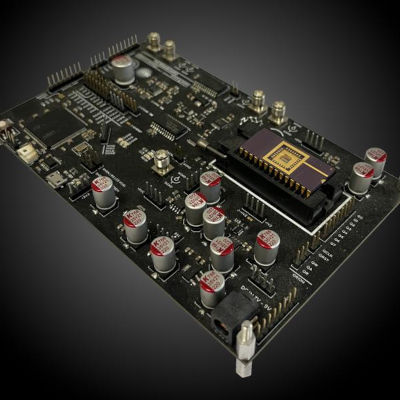

Researchers at Politecnico di Milano have created a new chip that cuts energy use and speeds up handling large amounts of data. The chip comes from the ANIMATE project, which received a major grant in 2022 to build better computing technology. This project focuses on in-memory computing, a method that does calculations directly in the memory to avoid moving data back and forth to a separate processor. Moving data like this in normal computers wastes time and energy, like traffic jams inside the machine. By fixing this, the chip makes systems faster and more efficient.
The chip is an analogue accelerator, meaning it uses continuous signals instead of digital on-off bits for processing. It is made with CMOS technology, a standard way to build small, reliable computer parts using metal and oxide layers. Inside, it has two sets of 64 by 64 arrays of programmable resistive memories, which can change their electrical resistance to store and process data, plus SRAM cells for quick temporary storage. The design also includes operational amplifiers and analogue-to-digital converters.
How the chip achieves efficiency
In tests, this setup lets the chip do complex math right in the memory structure, without sending data outside. This greatly lowers calculation time, power use, delay known as latency, and the space it takes on silicon. The chip matched the accuracy of regular digital systems but used less energy and worked quicker. It shows that analogue in-memory computing can work on a large scale, like in factories.
This innovation stems from work with partners at Peking University, involving experts, students, and others. It opens doors for real uses, such as in artificial intelligence to save energy, robotics for better control, data centers for handling big information loads, navigation tools for precise mapping, and future 6G networks for ultra-fast communication. The researchers are now exploring ways to apply it in everyday tech to make devices smaller, quicker, and greener.
This research is published in Nature Electronics.