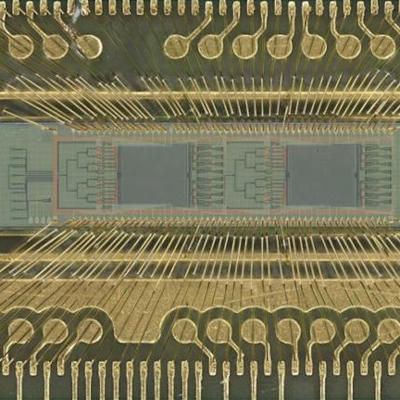

A new computer chip uses light instead of electricity to handle image recognition and similar tasks in artificial intelligence (AI). These tasks are essential for AI to process images, videos, and even language. The chip is much more efficient, using 10 to 100 times less power than traditional chips for the same calculations. This efficiency could help reduce the massive electricity demands of AI systems, which are putting pressure on power grids, and allow for more powerful AI models.
The chip focuses on a process called convolution convolution, a mathematical operation that helps AI identify patterns but requires significant energy and time. The new chip uses lasers and tiny lenses built into circuit boards to perform these computations faster and with less energy. In tests, the chip accurately identified handwritten numbers with 98% accuracy, matching the performance of standard chips.
How the Chip Works
The chip uses miniature Fresnel lenses. Data, such as images, is turned into laser light, passed through these lenses, and then converted back into a digital signal to complete the AI task. Using light for computing (photonics) is fast and efficient. The chip can also process multiple data streams at once by using different colors of laser light, a major advantage over traditional methods.
Developed by researchers at the University of Florida, the University of California, Los Angeles, and George Washington University, the chip was tested and described in a study published in Advanced Photonics.
The researchers used standard manufacturing techniques, making it easier for companies like NVIDIA, which already use some optical components, to adopt this technology. This light-based approach could become a standard feature in future AI chips, enabling faster and more sustainable AI systems.
“Performing a key machine learning computation at near zero energy is a leap forward for future AI systems,” said research leader Volker J. Sorger. “This is critical to keep scaling up AI capabilities in years to come.”