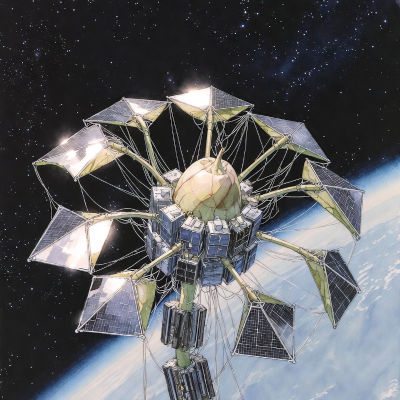

Engineers have made a new plan for data centers that orbit the Earth and run on solar power. These could grow large enough to meet the rising need for artificial intelligence (AI) computing. The design lowers the harm to the environment from ground-based data centers, which use a lot of electricity and water. It looks like a plant with stems holding computer parts and leaf-shaped solar panels. The key feature is tethers, which are long cables that naturally point the structure correctly in space due to gravity and spinning forces from orbit.
This setup avoids the need for constant changes to keep solar panels facing the sun. It stays steady mostly on its own, cutting down on weight, power use, and complexity. This makes it easier to build big versions with thousands of computing nodes able to handle AI inference.
Putting AI in orbit
Other plans for space data centers face scaling problems. Some suggest many separate satellites, needing millions to work well. Others want huge rigid buildings made by robots in space, but these are too complex to build now. The Penn design sits in between, using proven tether technology from past space studies. Nodes link along the tether to form a chain, like adding beads to a necklace, allowing easy growth.
Sunlight not only powers the panels but also helps control direction through solar pressure, a gentle push from sun rays that acts like wind on a vane. Simulations show the system could stretch kilometers, support 20 megawatts of power - equal to a medium Earth data center - and send data via lasers. It stays strong against micrometeoroids, tiny space debris that hits at high speeds. Impacts cause short wobbles that fade along the tether, keeping the whole thing stable.
For cooling, it uses radiators to release heat slowly into space, since there's no air or water there. Next steps include testing small prototypes. This could shift much AI work to orbit, easing Earth's resource strain as AI grows.