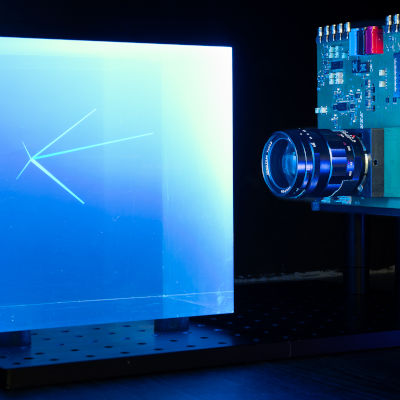

Particle physics experiments require precise tracking of weakly interacting particles such as neutrinos, which rarely collide with matter. Scintillators are materials that emit light when charged particles pass through them. Conventional detectors divide scintillators into millions of small segments, but this method becomes difficult and costly for larger volumes.
Scientists from ETH Zurich and EPFL have developed a new detector called PLATON. It uses a light-field camera to capture both light intensity and direction inside a single, unsegmented scintillator block. A micro-lens array placed in front of a special imaging sensor records the full light field, allowing reconstruction of particle paths in three dimensions.
The sensor is an array of single-photon avalanche diodes known as SwissSPAD2. These diodes detect individual photons with high sensitivity. Gated detection limits recordings to specific short time windows, reducing background noise.
Promising performance for neutrino detection and medical imaging
Laboratory tests with a radioactive source showed the prototype could locate electron positions inside a plastic scintillator block. Results agreed well with computer simulations, even when only a few photons were detected.
Simulations of an upgraded system, including improved sensors and a neural network based on Transformer architecture for image processing, indicate strong potential for neutrino experiments. Spatial resolution below one millimetre appears achievable in a 10-centimetre cube volume. For a one-cubic-metre detector, resolution of a few millimetres is realistic, matching current segmented detectors. The system could also select specific neutrino interactions with high accuracy.
The technology extends beyond particle physics. Patents have been filed for its use in positron emission tomography, or PET, scanners. PET is a medical imaging technique that uses radioactive tracers to view processes inside the body. The new method could enable higher-resolution total-body PET scans.
This approach combines existing tools in a novel way to overcome scalability limits in particle detection. Future upgrades in optics and timing resolution are expected to further improve performance for neutrino research and other applications.
This research is published in Nature Communications.