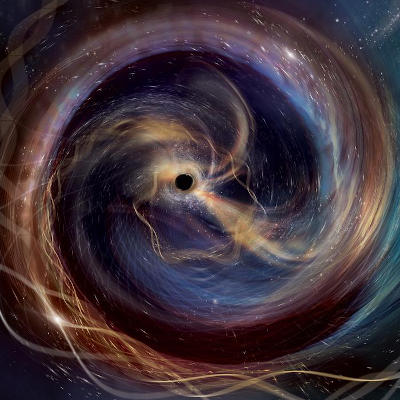

In 2015 the Laser Interferometer Gravitational-Wave Observatory (LIGO) detected gravitational wave signals from two black holes merging far away. Three LIGO founders won the 2017 Nobel Prize in Physics for this work.
Today LIGO works with Virgo in Italy and KAGRA in Japan. These gravitational wave observatories, collectively called LVK, detect about one black hole merger every three days. They have found over 300 mergers, with 230 candidates in the current run, more than double from earlier runs. Improvements in the detectors made this possible. The detectors measure space-time distortions, induced by gravitational waves, smaller than a proton's width.
Recent clear signals confirm Stephen Hawking' predictions's black hole area theorem
A recent merger, GW250114 from January 14, 2025, showed clearer waves due to less noise. It involved black holes, each 30 to 40 times the sun's mass, 1.3 billion light-years away. Analysis tested the black hole area theorem by Stephen Hawking. This theorem says a black hole's surface area, like its event horizon size where nothing escapes, cannot shrink. When black holes merge, the total area grows despite energy loss in waves. The merged black hole's area increased from United Kingdom size to nearly Sweden size. This verified the theorem with high confidence.
This study, titled "GW250114: testing Hawking’s area law and the Kerr nature of black holes," is published in Physical Review Letters.
Other press releases (all embargoed until September 10) have been issued by participating institutions, including:
Clearest signal yet from colliding black holes yields most precise confirmation of Hawking’s area theorem
Ringing black hole confirms Einstein and Hawking’s predictions
An unprecedented view of merging black holes
Hawking and Kerr black hole theories confirmed by gravitational wave
Ten years after the discovery, gravitational waves verify Stephen Hawking's Black Hole Area Theorem
In related studes, scientists performed other very accurate tests of Einstein's general relativity.
Other findings include neutron star-black hole mergers, uneven mass pairs, light black holes filling a mass gap, and a huge 225 solar mass merger. Future upgrades will reach farther, with new detectors like LIGO India. Larger ones, Einstein Telescope in Europe and Cosmic Explorer in the US, could detect early universe events. A space detector, LISA, is planned.