
Rice University neuroengineer Jacob Robinson and his team have designed a new magnetic-to-electric conversion material that is 120 times faster than similar materials. It can stimulate neurons remotely or bridge the gap in a broken sciatic nerve (tested using a rat model).
In a study published in the journal Nature Materials, the researchers showed that the new material could allow for neurostimulation treatments (such as transcranial magnetic stimulation) with less-invasive procedures. Instead of implanting a neurostimulation device, tiny amounts of the material could simply be injected at the desired site.
Stimulating 120-times-faster neural activity
The researchers started with a magnetoelectric material made up of a piezoelectric (generating electrical current from shape changes) layer of lead zirconium titanate sandwiched between two layers of metallic glass alloys. This material could be rapidly magnetized and demagnetized.
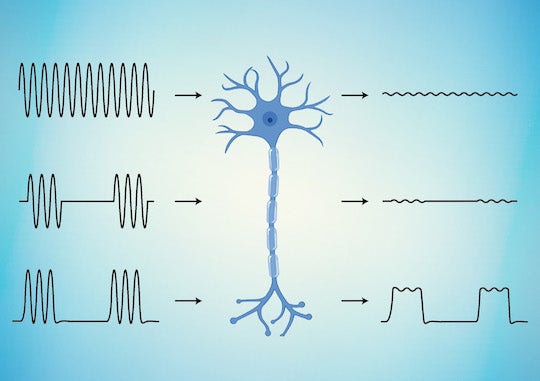
The researchers stacked layered platinum, hafnium oxide and zinc oxide on top of the original magnetoelectric film. This made it 120 times faster at stimulating neural activity, compared to previous magnetic materials and with a layer thiner than 200 nanometers (so in the future it could be injectable).
Proof of concept in neuroprosthetics
The researchers used the material with rats to stimulate peripheral nerves, restore function in a severed nerve, and prove fast electric signal speeds.
According to the researchers, the new metamaterial overcomes many challenges in neurotechnology, and this framework for advanced material design can be applied toward other applications, like sensing and memory in electronics.
The research was supported by the National Science Foundation (2023849) and the National Institutes of Health (U18EB029353).
Citation: Chen, J. C., Bhave, G., Alrashdan, F., Dhuliyawalla, A., Hogan, K. J., Mikos, A. G., & Robinson, J. T. (2023). Self-rectifying magnetoelectric metamaterials for remote neural stimulation and motor function restoration. Nature Materials, 1-8. https://doi.org/10.1038/s41563-023-01680-4