
Quantum physics makes it hard to check quantum systems rapidly. Measuring these systems usually destroys them, which is a big problem for using them in technology. A new study shows a better way to verify entangled quantum states, which are pairs of particles linked so that what happens to one affects the other instantly, no matter the distance. These states are key for building quantum computers, machines that solve complex problems much faster than regular computers, and quantum networks for super-secure data sharing. Quantum state tomography methods rebuild a full picture of a quantum state through many measurements, but need lots of identical copies of the system. Each measurement ruins a copy, leaving none for actual use, and the number of copies grows hugely with system size.
Overcoming measurement challenges
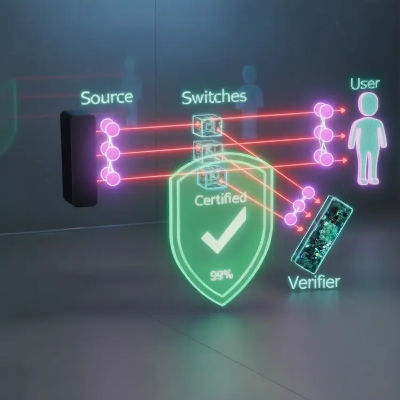
To fix this, scientists at the University of Vienna created a protocol that only checks a small random sample of the states. They use active optical switches, devices that quickly direct light signals without changing them. These switches send some quantum states to a verifier for testing and others straight to the user for the real task. Because the selection is random, the verifier can use statistics to confirm the quality of the unmeasured states without destroying them. This happens in real time, and it works even if the states are not all identical, which is common in real setups. It also allows device-independent certification, meaning the checks stay reliable even if testing tools might be faulty or tampered with.
The experiment used this setup with photons, proving it efficient and scalable. This reduces the resources needed and makes quantum tech more practical. It helps build trustworthy quantum communication networks and powerful photonic quantum computers. Overall, this method makes verifying quantum systems faster and less wasteful, paving the way for larger, more reliable quantum devices in the future.
The methods and results of the study are described in a paper published in Science Advances.