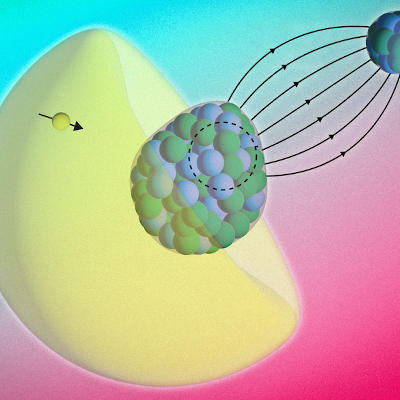

Scientists at MIT have found a new way to look inside an atom’s nucleus using its own electrons as helpers. They paired a radium atom with a fluoride atom to form a molecule called radium monofluoride. Inside this molecule, the radium’s electrons move around and sometimes dip into the nucleus, acting like messengers that carry information about its structure.
This method avoids the need for huge machines that speed up electrons to smash into nuclei. Instead, it uses a small setup on a table to study the nucleus directly. The researchers measured the energy of the electrons as they moved inside the molecule. They noticed a small energy shift, suggesting the electrons briefly entered the nucleus and interacted with its protons and neutrons. This shift gave them clues about the nucleus’s inside layout.
Molecular trap reveals nuclear secrets
The radium nucleus has a pear-like shape, unlike the usual round shape of most nuclei. This shape might help detect tiny differences, or symmetry violations, that could explain why the universe has more matter than antimatter. The Standard Model says they should be equal, but that’s not what we observe.
The molecule’s strong inner electric field, which is a force that pushes or pulls charges, squeezes the electrons, making it easier to study the nucleus.
The researchers trapped and cooled the molecules, then used lasers to measure electron energies precisely. The small energy shift they found proved the electrons touched the nucleus inside. This opens a way to map the nucleus’s magnetic distribution, which shows how protons and neutrons are arranged like tiny magnets. Future work will cool the molecules more to control their shape and hunt for symmetry violations, possibly solving big questions in physics about the universe’s makeup.
“Radium-containing molecules are predicted to be exceptionally sensitive systems in which to search for violations of the fundamental symmetries of nature,” note the scientists in an MIT press release. “We now have a way to carry out that search.”
The scientists have described the methods and results of this study in a paper published in Science.