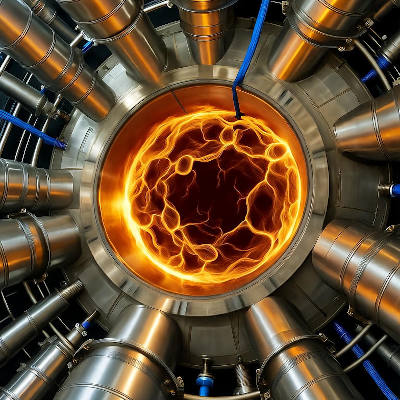

Tokamaks are donut-shaped machines that use strong magnets to hold and heat plasma, a super-hot gas of charged particles, to create fusion energy by smashing atoms together. This process mimics the sun's power and could provide clean, endless energy if done safely. Current tokamaks are mostly small research devices testing how to start and control plasma. A key problem is rampdown, the process of slowly reducing the plasma's electric current to turn it off safely when it becomes unstable. If not handled well, rampdown can cause the plasma to disrupt, damaging the machine's inside walls with intense heat.
Scientists at MIT have developed a new way to predict how plasma acts during rampdown. They combined machine learning with a physics model that simulates plasma movement based on basic rules. This hybrid approach was trained on data from the TCV tokamak in Switzerland, using information on plasma temperature and energy from hundreds of test runs. The model quickly learned to forecast plasma changes and spot instabilities with high accuracy, even with limited data, which is good because running tokamaks is costly.
Enhancing fusion reliability
The scientists also built an algorithm to turn predictions into actions for controlling the tokamak, like adjusting magnets to keep plasma stable. Tests on the TCV showed this method ramped down plasma faster and without disruptions compared to old ways. It lowered energy safely to zero, reducing risks. This work could help larger future tokamaks like SPARC, a demo plant aiming for net energy gain where output exceeds input. By preventing damage, the method supports reliable operation needed for fusion to become a practical power source. Support came from fusion companies and research programs, pointing to ongoing efforts for safe, efficient nuclear fusion energy.
The scientists have detailed the methods and results of this study in a paper published in Nature Communications.