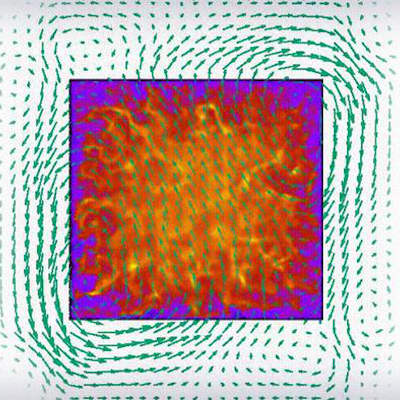

Researchers found a better way to simulate electric fields in plasmas. Plasma is the fourth state of matter, full of charged particles. It’s used to make computer chips and coat materials. Simulating plasmas is hard because it needs millions of calculations. These calculations happen thousands of times per second. Even fast supercomputers struggled to make detailed kinetic simulations. Kinetic simulations track individual particles.
The new method makes these simulations faster and more stable. Researchers from Princeton Plasma Physics Laboratory, University of Alberta, and Los Alamos National Laboratory worked on this. They partnered with Applied Materials Inc., a company that makes chip equipment. They published their findings in Physics of Plasmas.
The simulation focuses on inductively coupled plasmas. In these plasmas, a coil with electric current creates a magnetic field. This magnetic field makes an electric field that heats the plasma. The simulation, called a particle-in-cell code, tracks particles as they move. This works well for low-pressure plasmas in industrial devices. A fluid approach, which uses averages, doesn’t work for these plasmas.
A More Reliable Code
This work connects physics, math, and computer science. The researchers improved the code to stop crashes. The code became very reliable. It now simulates plasmas in two dimensions. The researchers adjusted how the solenoidal electric field was calculated. The improved code models larger plasmas quickly. It also follows the law of conservation of energy. This law says energy can’t appear or disappear. In simulations, small errors can grow over millions of steps. Conserving energy keeps the simulation accurate.
This seems a big step forward. This work could helps make better chips and memory devices. It could also supports fusion research.
“This is a big step forward in our capabilities,” said researcher Igor Kaganovich in a press release. “This new simulation allows us to model larger plasmas quickly."