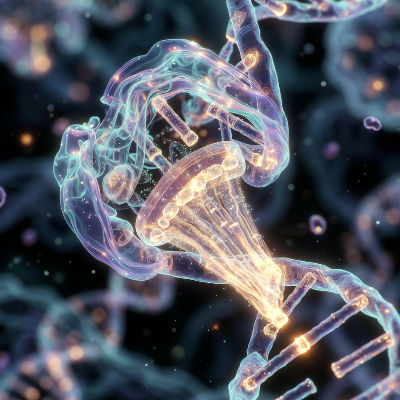

Scientists have discovered a new version of the CRISPR gene-editing system found in nature. Unlike standard CRISPR tools that locate and cut DNA, this variant can turn genes on without making any cuts. The findings come from two related studies (1, 2) published together in Nature. One study explores what the system does inside living cells, while the other explains exactly how it works at the molecular level.
CRISPR stands for Clustered Regularly Interspaced Short Palindromic Repeats. It is a natural defense system that some bacteria use against viruses. Scientists have turned it into a popular tool for editing genes.
In the usual CRISPR approach, a short piece of RNA acts as a guide. It leads a protein complex to a specific spot on DNA, where the complex cuts the DNA strand. The new system works differently. The RNA guide still directs the complex to the target gene, but instead of cutting, the complex brings in the cell’s own gene-activating machinery. This machinery includes RNA polymerase, an enzyme that reads DNA and makes a copy in the form of RNA, which then leads to protein production. The result is that the gene is switched on and begins to work.
Toward safer and more flexible gene editing
A key advantage is that the system can activate genes even in DNA regions that lack a normal starting signal called a promoter. This gives it more flexibility than many current tools.
Researchers used cryo-electron microscopy to see the complex in great detail. This technique freezes samples and uses electrons to create near-atomic images. They also ran biochemical tests to confirm how the parts fit together and trigger gene activation.
The discovery expands knowledge of how CRISPR systems have evolved in nature. It could lead to safer ways to control genes for research or future medical treatments without permanently changing the DNA sequence.