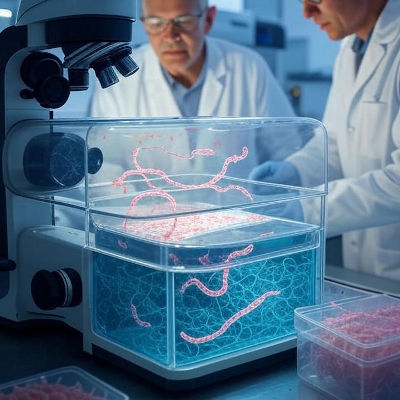

In medicine and biotechnology, evolving proteins to gain new or better functions is vital, but usual methods are slow and require much effort. Scientists at Scripps Research have created a synthetic biology platform called T7-ORACLE that makes evolution happen much faster in the lab.
This allows proteins to develop useful new traits thousands of times quicker than in nature. The platform helps engineer proteins for treating conditions like cancer and neurodegeneration. This research is published in Science.
Directed evolution is a lab technique where mutations, or changes in genetic code, are added to proteins, and the best versions are selected over cycles. It creates things like antibodies or enzymes. Traditional ways need repeated DNA handling and testing, taking a week or more per cycle. Continuous evolution systems let proteins change inside living cells without human steps, happening with each cell division, about every 20 minutes in bacteria.
T7-ORACLE uses E. coli bacteria modified to have a second DNA replication system from bacteriophage T7, a virus that infects bacteria and replicates efficiently. This orthogonal system, meaning it works separately from the cell's own machinery, targets only plasmid DNA, small circular genetic pieces, without harming the host genome, the cell's main DNA.
How the system demonstrates its power
The scientists put a gene for antibiotic resistance, TEM-1 β-lactamase, into the system and exposed cells to increasing antibiotic doses. In under a week, it evolved enzyme versions resisting up to 5,000 times higher levels. The mutations matched those seen in real medical cases, and some new combinations worked even better. This benchmark proves the system's speed and relevance, but it applies to any protein, like those for cancer drugs.
T7-ORACLE is easy to use with standard lab setups, needing no special tools. It combines high mutation rates with fast cell growth. Future uses include evolving unnatural nucleic acids for synthetic genomics, the creation of artificial genomes. Currently, focus is on human enzymes for therapy and proteases, enzymes that break down proteins, targeting cancer sequences. This advance merges planned design with fast evolution for efficient discovery of functional molecules.