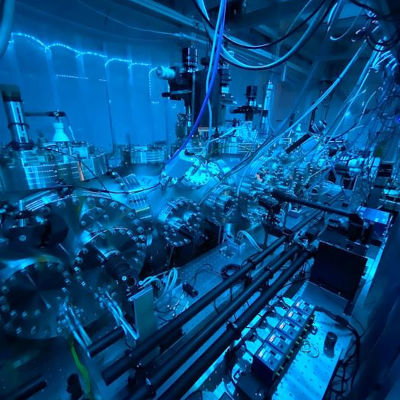

Quantum mechanics describes how particles like atoms and electrons can act as both particles and waves, sometimes existing in multiple states at the same time. This includes superposition, where something can be in two places or states simultaneously until measured. In everyday life, larger objects follow classical physics, with fixed positions and paths. However, researchers have now shown that even big nanoparticles about 8 nanometers wide, made of 5,000 to 10,000 sodium atoms, follow quantum rules.
These clusters, with a mass over 170,000 atomic mass units, were tested in an experiment using laser beams as diffraction gratings, which are patterns that split and bend waves. The particles were cooled and sent through three ultraviolet laser gratings, creating a superposition where each cluster's path was uncertain, like being "here and not here" at once. At the end, they formed a striped interference pattern, a wave-like overlap proving quantum behavior. This delocalization, or spread-out position, was dozens of times larger than the particle itself, similar to Schrödinger's cat thought experiment, where a cat could be both dead and alive in superposition.
Pushing quantum limits further
The study, published in Nature, achieves a macroscopicity value of 15.5, a measure of how well the experiment tests quantum theory against alternatives, which is about ten times higher than previous tests. This means the quantum state lasted about 0.01 seconds. The work rules out small changes to quantum theory and shows it holds for objects as big as some proteins or transistor parts.
In the future, this could lead to better sensors for tiny forces and new ways to measure nanoparticle properties. The Vienna lab plans to test even larger objects to explore why quantum effects fade in the everyday world. Funding came from groups like the Gordon and Betty Moore Foundation and Austrian science funds, embedding the work in broader physics programs.