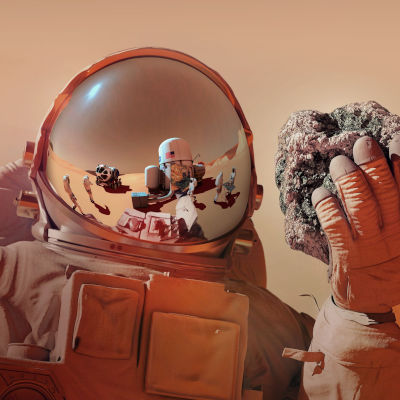

Sending humans to Mars will be an incredibly expensive and lengthy process, so NASA requires a strong justification for the journey. A new report published by the National Academies of Sciences, Engineering, and Medicine argues that the primary reason to go is to discover if life exists, or ever did exist, beyond Earth, Ars Technica reports.
The document represents the consensus of leading experts who spent two years identifying the most urgent scientific objectives for future astronauts. While private companies are currently building the rockets to make the trip possible, this study provides the scientific arguments for why people should go, rather than just robots.
The committee identified several top priorities. The most critical is the search for life, which involves looking for biological evidence in the soil and rocks. Other key goals include understanding the geology and weather patterns of Mars, specifically its massive dust storms. The experts also emphasized the need to study how space travel affects human physical and mental health. Additionally, the plan calls for using local materials found on Mars to create necessary supplies like water and fuel.
Balancing exploration and safety
To achieve these goals, the group recommends a specific strategy. They suggest starting with a short human landing that lasts 30 days. This would be followed by a cargo delivery to support a much longer mission of 300 days. All activities would take place within a single exploration zone chosen for its geological history.
A major challenge addressed in the report is planetary protection. This is a safety principle designed to prevent Earth bacteria from contaminating Mars and to ensure that potentially harmful Martian materials are not brought back to Earth. While some argue that humans should avoid areas that might hold life to keep them pristine, the report urges NASA to update its guidelines. The authors believe protocols can be created that allow astronauts to safely research areas that might harbor life. Ultimately, the study concludes that while robots have studied Mars for decades, human explorers are necessary to perform complex experiments and finally answer the question of whether we are alone in the universe.
“The first human landing on Mars will be the most significant moment for human space exploration since we first set foot on the moon over 50 years ago,” notes a press release.