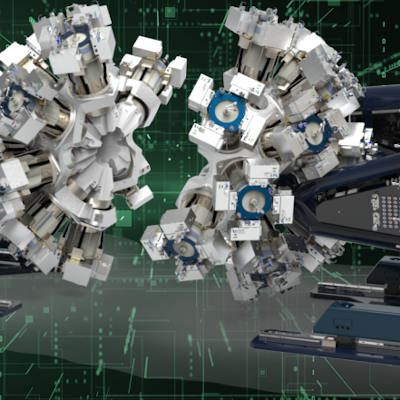

Researchers at Lawrence Berkeley and Oak Ridge national laboratories develop DELERIA, a software platform to analyze nuclear physics data quickly.
DELERIA stands for Distributed Event-Level Experiment Readout and Integrated Analysis. It supports GRETA, a new instrument called the Gamma Ray Energy Tracking Array.
GRETA, under construction at Berkeley Lab, will move to the Facility for Rare Isotope Beams at Michigan State University in 2026. This software sends data to top computing centers instantly, cutting analysis time from hours to seconds. A data pipeline, a system that moves and processes data, makes this possible. The Energy Sciences Network, or ESnet, a high-speed network, carries the data. This speed helps scientists adjust experiments in real time for better results.
GRETA uses 120 germanium crystals to study atomic nuclei. Samples inside GRETA get hit by charged particles from a radioactive ion accelerator, a machine that speeds up particles. These collisions release thousands of photons, or light particles, every second. Photons hit crystals, creating signals that DELERIA analyzes to show how protons and neutrons behave. This needs huge computing power to calculate photon energies and positions. DELERIA sends this work to distant data centers, avoiding the need for new local computers.
Testing and Future Potential
Researchers built a test version of GRETA’s data pipeline. A virtual GRETA at Berkeley Lab mimics photon collisions. Data travels over 4,000 miles via ESnet to Oak Ridge’s Defiant, a powerful 36-node computing cluster. Defiant calculates photon positions in crystals within 10 seconds. The pipeline processes 480,000 photon events per second and reduces stored data by 97.5%. Tests show it handles 35 gigabits per second, a measure of data speed, exceeding GRETA’s needs. ESnet’s fast network supports this.
Latency poses a challenge. Data takes 120 milliseconds to go round-trip, while processing takes 5 milliseconds. Researchers plan to process multiple events at once to cut delays and adapt DELERIA for other research facilities.