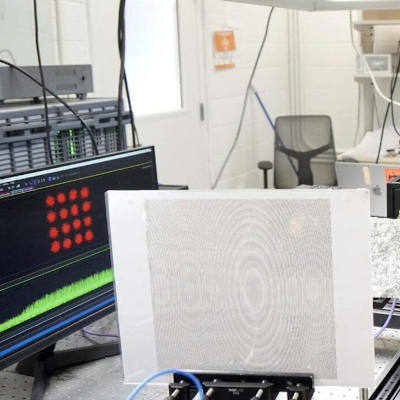

Ultrahigh frequency signals in the sub-terahertz band promise to carry ten times more data than current wireless systems. This speed could support advanced uses like virtual reality, where users experience simulated worlds, or autonomous vehicles that drive without human input. However, these signals form narrow beams that get easily blocked by walls, furniture, or even moving people, causing lost connections indoors.
Princeton researchers have created a system to overcome this. They use a technique to curve the beams around obstacles, drawing from Airy beams, a type of radio wave proposed in 1979 that bends like a thrown curveball. By shaping transmissions this way, signals can navigate complex spaces without direct line of sight.
The system pairs curved beams with a neural network. Unlike fixed reflectors that bounce signals but may not suit all spots, this adapts in real time. The researchers explain that it handles shifting environments by tweaking curve degree and position on the fly.
Neural network trains to optimize beam paths
Finding the ideal curve is hard, as endless options exist, making full scans impractical. Instead, the researchers trained the neural network through practice. They built a simulator using Airy beam physics to virtually test scenarios, speeding up training without real-world trials.
Once trained, the network quickly picks optimal curves based on physics principles, ensuring precise adjustments. Tests focused on controlling transmissions in experiments, showing reliable links in cluttered, changing areas.
This could overcome a key barrier to high-frequency adoption, paving the way for ultra-fast connectivity in tough settings. “With further advances, we envision transmitters that can intelligently navigate even the most complex environments, bringing ultra-fast, reliable wireless connectivity to applications that today seem out of reach," note the researchers in a press release, "from immersive virtual reality to fully autonomous transportation.”
The researchers have described the methods and results of this study in a paper published in Nature Communications.