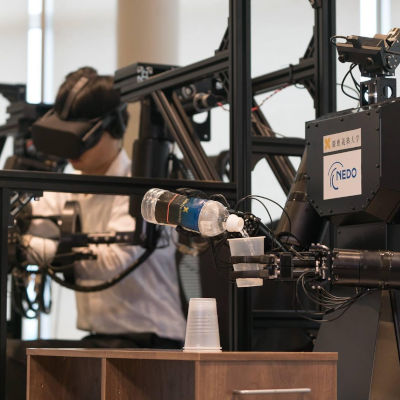

Robots have advanced quickly in automation, but most cannot easily adjust their pre-learned movements to changing settings with objects that differ in stiffness (how hard or soft something is) or weight. This limits their use in real-world tasks like cooking or helping older people, where objects vary. Humans naturally adapt their grip based on touch, but robots often lack this skill.
To fix this, researchers from Japan created a new adaptive motion reproduction system. This system records human movements and recreates them in robots, but it improves on older methods by handling unknown objects better.
The key innovation is Gaussian process regression, a math tool that maps complex, non-straight-line relationships with little data. Researchers trained the system on human grasping motions for several objects. It learns the link between an object's environmental stiffness (its resistance to force) and the human's position and force commands. This uncovers the human's motion intent, called human stiffness (the body's adjustment strategy), so the robot can apply it to new objects.
How the system outperforms others
Tests compared this method to traditional systems, linear interpolation (a simple way to estimate between known points), and basic imitation learning. The new approach cut errors in position by at least 40% and force by 34% for objects similar to training ones. For very different objects, it reduced position errors by 74%. It worked well with small datasets, making it efficient.
This breakthrough allows robots to interact with everyday items more like humans, expanding their role in industries. It lowers machine learning costs, aiding fields like life-support robots that must adapt often. The researchers build on past work in force and touch feedback, including sensitive arms and avatar robots. Overall, this paves the way for more versatile robots in dynamic environments.
The researchers have described the methods and results of this study in a paper published by the IEEE.