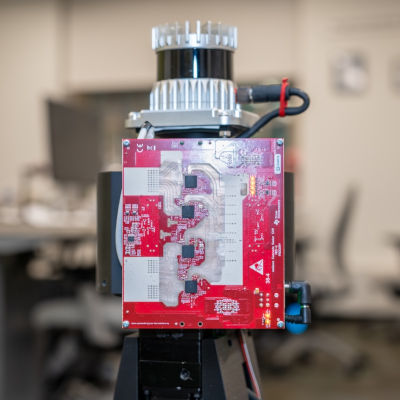

Engineers at the University of Pennsylvania have created a new system called HoloRadar that allows robots to detect objects around corners using radio waves and artificial intelligence (AI). This could make self-driving cars safer by spotting hidden pedestrians and help robots in busy places like warehouses avoid obstacles. Unlike older methods that use visible light, HoloRadar works well in the dark or changing light because it relies on radio signals.
The system captures radio waves that bounce off walls, floors, and ceilings. These surfaces act like mirrors for radio waves due to their long wavelengths, the distance between wave peaks, letting signals carry information about hidden areas back to the robot. HoloRadar then rebuilds a three-dimensional picture of what's out of sight.
How HoloRadar processes signals
To handle the messy echoes from multiple bounces, the system uses a special artificial intelligence setup that mixes machine learning with physical models. It first sharpens the raw signals to spot different reflection paths. Then it traces them back to map the real scene, sorting out direct hits from indirect ones. This is like figuring out true positions in a room of mirrors.
Tests showed HoloRadar working on a moving robot indoors, recreating walls, hallways, and people around corners. It adds to existing sensors like LiDAR, which uses lasers for direct-line detection, by revealing blind spots. Future plans include testing outdoors at longer ranges with more movement.
This advance gives robots a fuller view of their world, aiding safe operation in everyday settings. This research was presented ai the Conference on Neural Information Processing Systems (NeurIPS).
“This is an important step toward giving robots a more complete understanding of their surroundings,” says research leader Mingmin Zhao. “Our long-term goal is to enable machines to operate safely and intelligently in the dynamic and complex environments humans navigate every day.”