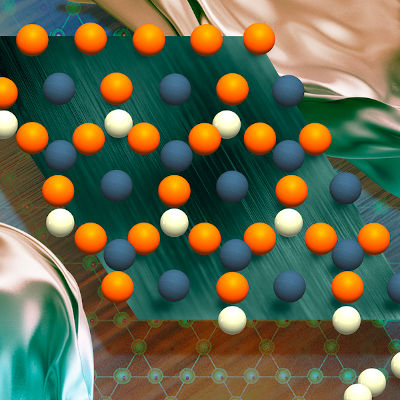

Artificial Intelligence (AI) models that turn text into images can also help design new materials. However, they often fail at designing materials with quantum properties such as superconductivity, or unique magnetic states. This is a problem because the process of finding such materials is slow. For example, after years of work on quantum spin liquids - materials with tangled magnetic fields useful for quantum computing - only a few candidates exist.
MIT researchers added rules, or constraints, to guide the models. These rules ensure the models make materials with specific shapes, like geometric lattices, patterns of points that lead to quantum effects. The models usually focus on stable materials, but the researchers wanted ones with impact, even if less stable. The researchers described their method in a paper published in Nature Materials. Using it, they generated millions of candidate materials with structures linked to quantum traits. From these, they made two real materials with rare magnetic properties.
Guiding AI for better discoveries
The key tool is SCIGEN, short for structural constraint integration in generative model. This tool makes diffusion models, a type of AI that builds things step by step, follow user rules. They tested it on DiffCSP, a materials AI model, to create Archimedean lattices, 2d patterns of shapes like triangles that can lead to quantum spin liquids or flat bands, which reproduce the properties of rare earths without rare earth elements. The model made over 10 million candidates, screened a million for stability, and simulated thousands on supercomputers to check atomic behavior. Tests showed 41 percent had magnetism. Then the researchers synthesized two previously undiscovered compounds, TiPdBi and TiPbSb. Laboratory tests confirmed AI predictions.
This could speed up finding quantum spin liquids for stable quantum bits, or qubits, the building blocks of quantum operations. Experts say it helps predict materials for electronics and magnets. Future work may add rules for chemistry or function to find even more useful materials. Experimentation remains key to test if they can be made and work as expected.