
Genes are the basic units of heredity in living things, and gene networks are systems where genes interact to control cell functions. In the past, studies focused on simple reactions of cells to single triggers. More recent work aims to examine complex gene networks to spot targets for control.
Researchers at KAIST have now created a broad technology that pinpoints gene control targets in changed cell gene networks and fixes them back to normal. This could help in areas like turning back cancer changes, making new drugs, tailoring treatments to individuals, and reprogramming cells for therapy.
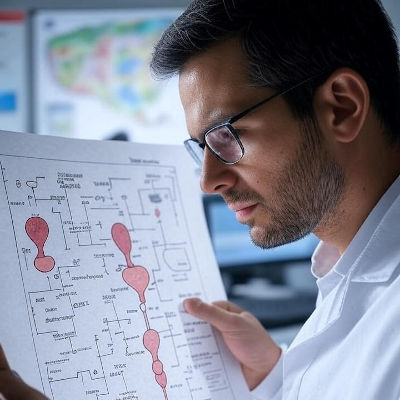
The method uses an algebraic approach that turns gene networks into math equations and solves them to find control points. Gene interactions are shown as a logic circuit diagram, known as a Boolean network, where genes act like switches that are on or off. Cell responses to outside signals appear as a landscape map, or phenotype landscape, which pictures possible cell states.
To handle this, the researchers apply a semi-tensor product, a math tool that figures out all gene mixes and their effects in one formula. With thousands of key genes making calculations hard, they use mathematical approximations to turn tough problems into easier ones with close results.
Enhancing predictions with math
This lets the researchers work out a cell's stable state, called an attractor, where the cell settles, and forecast shifts when a gene is adjusted. The researchers can then find main gene targets to shift abnormal responses toward normal ones.
The technology was tested on different gene networks, proving it predicts targets that return changed cell reactions to normal. For bladder cancer cells, it found targets to fix responses. In immune cell growth with large twisted networks, it spotted targets for normal patterns, solving issues that once needed long computer runs now done quickly.
This research is published in Science Advances. The researchers see it as a key step for the Digital Cell Twin model, a virtual setup that mimics cell reactions for simulations without real tests. It holds promise for life sciences and medicine, from cancer reversal therapies to cell reprogramming.