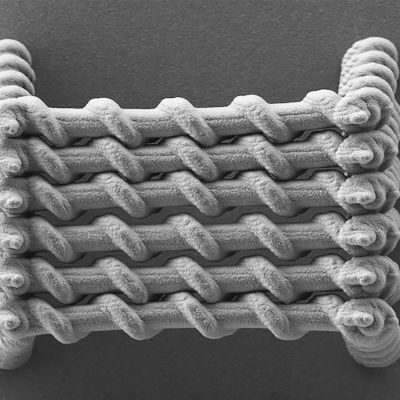

In traditional electronics, electrons physically flow through a circuit, which creates friction and results in significant energy loss in the form of heat. Magnonic systems avoid this issue because they do not rely on a flow of electrons. Instead, they utilize a collective excitation known as a spin wave, or magnon. This is a ripple of magnetic orientation that travels through a magnetic material, much like a wave moving across the surface of a pond, while the electrons themselves remain stationary. However, previous attempts to build three-dimensional magnonic systems faced major hurdles because they typically required powerful magnetic fields or extremely cold temperatures.
Researchers led by EPFL have overcome these obstacles by developing a new fabrication method that functions effectively at room temperature. The researchers created nanoscale tubes made of nickel and physically twisted them. By forcing this spiral shape onto the nickel, the scientists created a path where spin waves can move in only one direction. This creates a diode that allows signals to pass one way while blocking them in the opposite direction.
This research is published in Nature Nanotechnology.
A path toward brain-inspired computing
This directional flow allows for the encoding of binary information, such as zeros and ones, based on the direction of the spiral twist. The manufacturing process involves 3D printing a twisted rod made of polymer and coating it with a very thin layer of nickel. The resulting tubes are stable, nonvolatile, and can be mass-produced using existing technology found in the microelectronics industry.
The researchers ndicates that this engineering achievement supports the future of neuromorphic computing. This term describes computer architectures designed to mimic the three-dimensional structure and energy efficiency of the human brain. While hardware-based neuromorphic computing is essential for optimizing artificial intelligence (AI), it requires low energy consumption to be practical. By eliminating the need for extreme cooling and utilizing stable magnetic storage, this new technology offers a viable foundation for the next generation of AI hardware.