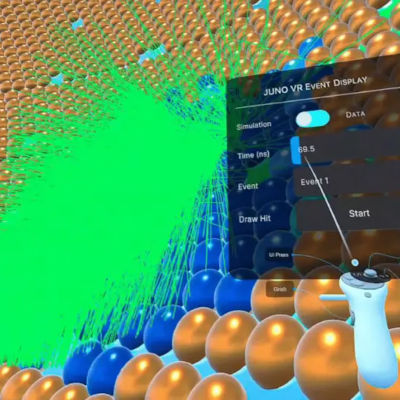

Physicists have created a virtual reality (VR) system to show detailed views of particle detectors and events. This tool overcomes the problems of older methods, which struggle with 3D images and working on different devices. It is especially useful for the Jiangmen Underground Neutrino Observatory (JUNO), a large experiment studying neutrinos. The system uses the Unity software to build immersive scenes based on real data from the experiment's offline programs. It keeps accurate details of thousands of photomultiplier tubes (PMTs), which are sensors that detect faint light signals.
The VR setup runs on a head-mounted display called Meta Quest 3. Users wear the headset and hold controllers to interact with a spatial user interface. This interface has panels to control parts of the detector and display event data. People can manage sub-detectors, touch individual units, and move freely around the virtual space to inspect inside the detector and see physics events up close.
Interactive features for detector analysis
The system shows PMT hits - detections of particles - using colors from light blue to dark blue to indicate how many hits occur. It also simulates the paths of photons with a fast particle system. For different events, it offers special views. In inverse beta decay (IBD), a neutrino reaction producing a positron and neutron, it highlights the short delay of about 170 microseconds between signals. For cosmic muons - high-energy particles from space - it recreates their paths and energy left in the detector. Users can replay these at tiny time steps, like nanoseconds.
This VR platform helps in studying neutrino signals and finding rare events during the detector's operation. It lets researchers spot patterns or unusual data in complex sets. The researchers note that using this VR feels like being inside the detector, allowing free exploration of 3D data from many angles to find hidden details. Future work will expand this for more in-depth neutrino physics discoveries.
This research is published in Nuclear Science and Techniques (arXiv preprint).