
Organic chemistry deals with compounds made of carbon. Nature often joins heavy metal atoms with light organic compounds using porphyrins, which are ring-shaped molecules that can hold a single metal ion like iron or magnesium in the center. These structures are key to hemoglobin in blood, chlorophyll in plants, and many enzymes.
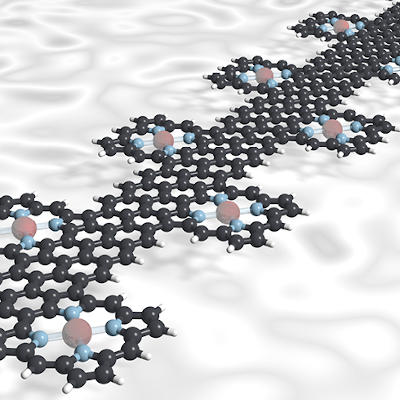
Depending on the metal inside, porphyrins show different chemical and physical traits. Scientists have wanted to use this variety for molecular electronics, tiny devices at the scale of molecules. To make such devices work, molecules need connections like wires. Researchers have attached porphyrins to a graphene nanoribbon with exact precision. Graphene nanoribbons are long, thin strips of graphene, a flat sheet of carbon atoms, and they can conduct electricity, show magnetism, or have quantum effects based on their shape and edges.
The researchers used a nanoribbon one nanometer wide with zigzag edges as a wire. Porphyrins dock along these edges at regular spots, switching sides. This ribbon has a special magnetism from its edges, where spin spreads out. The metal in the porphyrin has localized spin on the atom. Linking them combines both types of magnetism in one system.
Versatile molecular systems for new electronics
This setup turns the ribbon into a conductor for electricity and magnetism, like a tiny cable. It could act as qubits, units of quantum information, for quantum technology. Porphyrins are pigments that emit light, and their color shifts with the system's magnetic state, like a chain of lights for reading data. Light can also excite porphyrins to change the ribbon's properties. They can be modified to sense chemicals, altering conductivity when binding to targets.
Starting molecules are heated on gold under vacuum to form chains with atomic accuracy. This is confirmed by scanning tunneling microscopy, which images surfaces at atomic level, and non-contact atomic force microscopy, which maps forces without touching. Next steps include testing different metals and wider ribbons. This work is published in Nature Chemistry.