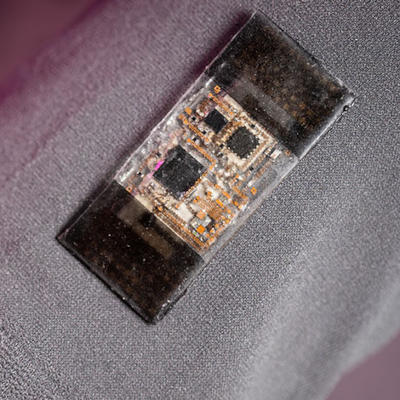

Engineers at UC San Diego have created an advanced wearable system that lets people use simple hand gestures to control machines, even when moving quickly, such as running, riding in a car, or dealing with rough ocean waves.
This research, published in Nature Sensors, combines stretchable electronics with artificial intelligence (AI). Older wearable devices with gesture sensors work well when a person is still, but signals get confused by too much motion noise in everyday situations. This new system fixes that by using AI to remove the noisy data instantly, allowing gestures to work reliably in busy real-world settings.
The technology could help people in rehabilitation or those with limited movement by letting them use natural gestures to guide robotic helpers without needing exact hand control. It might also assist factory workers or emergency helpers with hands-free operation of tools or robots in fast or dangerous places. For divers or remote users, it could direct underwater robots despite strong currents. In regular gadgets, it could improve gesture controls for daily use.
System design and testing
The device is a soft electronic patch attached to a cloth armband. It includes sensors for motion and muscles, a Bluetooth microcontroller, a small wireless computer chip for sending data, and a flexible battery, all in a small layered setup. It was trained on mixed data from real gestures and conditions like running, shaking, or wave motions. Arm signals are collected and handled with custom deep-learning AI that processes data in layers to remove interference, understand the gesture, and send commands to a machine like a robotic arm right away.
Tests showed strong results in tough spots. Users controlled a robotic arm while running, under strong vibrations, or both. It was checked in fake ocean settings with a simulator that copies sea motions, always giving accurate results with low delay, meaning quick response time. The project began to aid military divers with underwater robots, but it solves a broad issue in wearable tech where movement often ruins performance. This creates a new approach for sensors to handle noise, leading to future systems that stretch, connect without wires, and learn from complex settings and users.