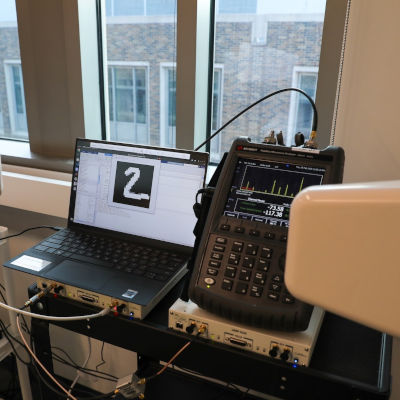

Drones check forests, robots move in warehouses, and sensors watch city streets, all making choices on their own at the edge of big networks. Edge computing means decisions happen on small devices that collect data, away from central computers. But shifting to this is tough because artificial intelligence (AI) models keep getting bigger, while device hardware stays small. Engineers usually store the whole model on the device, which needs lots of memory and power that quickly drains batteries. Or they send it to the cloud, far-away servers, but that causes delays, uses more energy, and risks data security.
Researchers at Duke University are testing a new idea called WISE, short for Wireless Smart Edge networks, to avoid these problems. They embed the weights into radio waves sent from nearby base stations to devices. This lets small gadgets use powerful AI without storing everything or sending data back and forth.
How WISE works
At its core, WISE uses in-physics analog computing, where math happens naturally through radio waves instead of converting data to binary code, ones and zeros processed digitally. A base station holds the full model and broadcasts a radio signal with the weights. When it reaches the device, simple hardware like a frequency mixer multiplies the incoming wave with the device's data in the analog domain, like radio frequencies, without needing a digital chip. This skips big energy costs and memory use.
Tests in the lab show WISE can classify thousands of images with 96 percent accuracy very fast, using much less power than normal processors. It works with current 5G or WiFi setups, adding no new parts. Benefits include helping drones in rescues or traffic cameras manage signals better. Though still early, with limits on distance and handling multiple models, this could make future networks blend talking and thinking to spread smart tech widely and save energy.
The researchers have described the methods and results of this study in a paper published in Science Advances.